>
>
>
Research mentorship for environmental science students
Research mentorship for environmental science students
Research mentorship for environmental science students | RISE Research
Research mentorship for environmental science students | RISE Research
RISE Research
RISE Research
TL;DR: This post explains what research mentorship for environmental science students actually involves at the high school level, which topics are realistic, which journals publish student work, and how the process connects to university admissions. The core insight: you do not need a lab or field equipment to produce original environmental science research. If your child is ready to start, book a free Research Assessment before the Summer 2026 Priority Deadline on approaching soon.
Most high school students who love environmental science spend their time reading about climate change, ecology, or conservation policy rather than contributing to those fields. That gap, between consuming knowledge and producing it, is exactly where research mentorship for environmental science students makes a difference. Original research is not reserved for university students with laboratory access. A motivated high school student, working with the right mentor, can design a study, analyze real-world data, draw original conclusions, and publish findings in a peer-reviewed journal before submitting a single university application.
The environmental science field is also unusually well-suited to high school researchers. Much of the most compelling work in this discipline draws on publicly available datasets, observational methods, policy analysis, and computational modeling. None of those approaches require specialized equipment. What they require is intellectual rigor, a well-defined research question, and a mentor who knows the field well enough to keep the work honest.
This post covers what environmental science research looks like at the high school level, which topics are realistic and academically credible, how RISE matches students to PhD mentors in this field, where the work gets published, and how the entire process connects to university admissions outcomes.
What Kind of Environmental Science Research Can a High School Student Actually Do?
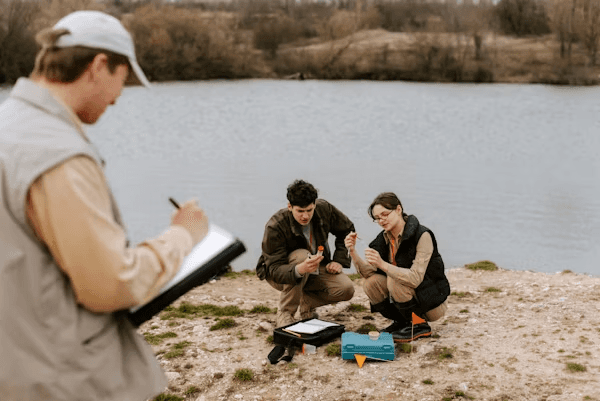
High school students can conduct original, publishable environmental science research using publicly available datasets, observational fieldwork, policy analysis, systematic literature reviews, and computational modeling. No laboratory, no specialized instruments, and no university affiliation is required to produce work that meets peer-review standards in this field.
Environmental science is one of the most methodologically diverse subjects available to high school researchers. A student in a city apartment can analyze satellite-derived land use data. A student near a coastline can design an observational study on shoreline erosion. A student with strong quantitative skills can build a predictive model using open-source climate datasets from NOAA or NASA. The subject rewards intellectual curiosity far more than physical access to resources.
Here are five specific research directions that RISE students have pursued or that are well within reach for a motivated Grade 10 to 12 student:
The Relationship Between Urban Green Space Coverage and Surface Temperature Anomalies in Mid-Sized Cities: Uses satellite imagery and municipal land-use data; suitable for journals covering urban ecology and climate adaptation.
Evaluating the Effectiveness of Marine Protected Area Policies on Fish Stock Recovery: A Comparative Analysis: Draws on published fisheries data and policy documents; methodologically a systematic review with quantitative synthesis.
Microplastic Concentration Patterns in Freshwater Systems: A Meta-Analysis of Existing Field Studies: No fieldwork required; synthesizes published data to identify geographic and seasonal patterns.
Carbon Sequestration Potential of Urban Tree Canopy Expansion: A Modeling Study for Residential Neighborhoods: Combines publicly available biomass equations with local tree census data; computational and policy-relevant.
The Impact of Agricultural Runoff Regulations on Nitrogen Loading in Watershed Systems: A State-Level Policy Analysis: Qualitative and quantitative; draws on EPA water quality databases and state legislative records.
The right topic depends on your child's specific interests within environmental science. That is exactly what the first mentorship session is designed to find.
The Environmental Science Mentors Who Guide RISE Students
RISE matches students to mentors based on research overlap and subject fit, not availability. A student interested in climate modeling will not be paired with a mentor whose work focuses on conservation biology. The match is specific, and that specificity is what makes the research credible.
Dr. Veeri holds a PhD from the University of Oxford and researches terrestrial carbon cycling and land-atmosphere interactions. RISE students working on carbon sequestration, land use change, or climate feedback mechanisms are frequently matched with Dr. Veeri because her research sits directly at the intersection of ecology and atmospheric science.
You can browse all environmental science mentors on RISE to see the full range of research backgrounds available to incoming students.
What a Real Environmental Science Research Project Looks Like from Start to Finish
Anika, a Grade 11 student from Singapore, came to RISE with a strong academic record in biology and chemistry but no clear sense of how to channel her concern about coastal ecosystem degradation into something academically substantive. She had read widely about mangrove loss in Southeast Asia but had not considered that she could contribute original analysis to that conversation.
In her first session with her RISE mentor, a marine ecologist with a PhD from the University of Edinburgh, Anika identified a gap in the published literature: while studies documented mangrove loss rates at the regional level, few had examined the correlation between specific land tenure policies and loss rates at the district level across multiple countries. That gap became her research question.
Over eight weeks, Anika built a comparative dataset using satellite-derived land cover data from Global Forest Watch, cross-referenced with national land tenure records and published loss rate statistics. Her methodology was quantitative and reproducible. Her mentor guided her through the statistical analysis and helped her frame the policy implications with appropriate academic caution.
Her paper was submitted to the Journal of Environmental Management and accepted following peer review. When Anika applied to universities, her Common App essay and research supplement described not just what she had studied, but what she had discovered and where that discovery now lived in the academic record. She received offers from University College London and the University of Toronto's environmental science program.
You can read more about how RISE students develop their projects on the RISE student projects page.
Which Journals Publish High School Environmental Science Research?
Several peer-reviewed journals accept high-quality environmental science research from high school authors. The most relevant are the Journal of Environmental Management, Consilience: The Journal of Sustainable Development, the Young Scientists Journal, and Frontiers for Young Minds. Each serves a different type of study and level of selectivity.
The Journal of Environmental Management is a Scopus-indexed journal that publishes applied environmental research. It is competitive, but well-scoped student work on policy analysis, ecosystem management, or quantitative environmental assessment can meet its standards with strong mentorship. Publication here carries significant weight in university applications because admissions readers recognize the journal's standing.
Consilience: The Journal of Sustainable Development, published by Columbia University, focuses on interdisciplinary research at the intersection of environment, development, and policy. It is particularly well-suited for students whose work bridges environmental science and social systems. The journal has a track record of publishing undergraduate and advanced secondary-level research.
The Young Scientists Journal is peer-reviewed and specifically designed for researchers aged 12 to 20. It covers life sciences, physical sciences, and environmental topics. For students who are publishing for the first time, it offers a rigorous but accessible entry point into academic publishing.
Frontiers for Young Minds publishes science articles reviewed by young people, with guidance from senior scientists. Environmental and earth science submissions are among its most active categories. The review process is genuinely educational, and the journal is indexed and citable.
You can explore the full range of publication venues RISE students have used on the RISE publications page. Your RISE mentor will advise on which journal is the right fit for your specific research question. Some topics suit more than one venue.
How RISE Environmental Science Research Mentorship Works, Week by Week
The program begins with a free Research Assessment, which is a 20-minute conversation, not an interview or test. The goal is to understand what your child finds genuinely interesting within environmental science, what prior coursework or independent reading they have done, and what kind of research question might sit at the edge of their current knowledge. From that conversation, RISE identifies the right mentor match and the right methodological direction.
In the first two weeks of the program, the student and mentor work together to develop the research question. This is collaborative, not assigned. The mentor brings knowledge of where the gaps in the literature are. The student brings their specific curiosity. The research question that emerges from that exchange is one the student genuinely owns, which matters enormously when they write about it in a university application.
Weeks three through eight form the active research phase. For most environmental science students, this involves a combination of dataset identification, literature synthesis, methodological design, and analysis. Weekly sessions with the mentor cover progress, address analytical challenges, and keep the work moving toward a defensible conclusion. The mentor does not write the research. They ask the questions that help the student write it better.
In weeks nine and ten, the focus shifts to submission and application strategy. The mentor helps the student prepare the manuscript for the target journal. Simultaneously, the student works with RISE advisors to translate the research experience into their Common App activities section, their research supplement, and, where relevant, their personal statement. RISE scholars who complete this process enter their application cycle with something most applicants do not have: a published, citable piece of original work.
RISE scholars are admitted to top universities at a rate three times higher than the general applicant pool. The RISE results page documents specific acceptance outcomes across institutions.
The Summer 2026 cohort is now open for applications. If your child is interested in environmental science and wants to publish original research before their university applications, book a free 20-minute Research Assessment here to find out whether the timing and topic are the right fit.
Frequently Asked Questions About Environmental Science Research Mentorship
Does my child need field equipment or a laboratory to do real environmental science research?
No. The majority of publishable high school environmental science research uses publicly available datasets, policy documents, published literature, or observational methods that require no specialized equipment. Agencies like NOAA, NASA, the EPA, and the World Bank publish extensive open-access environmental datasets that support rigorous original analysis.
Some of the strongest student research in this field is methodologically quantitative but logistically simple: downloading a dataset, cleaning it, running statistical analysis, and drawing conclusions that have not been drawn before. A student with a laptop and a well-defined research question has everything they need to start.
What academic background does a student need before starting environmental science research?
A student who has completed or is currently enrolled in high school biology, chemistry, or earth science has sufficient background to begin. No Advanced Placement or A-Level coursework is required, though students with some exposure to statistics or data handling tend to move through the quantitative phases of research more quickly.
The RISE Research Assessment identifies any foundational gaps early. If a student needs to build background in a specific area before the research question can be addressed rigorously, the mentor will address that in the first two weeks of the program. The program is designed for motivated students, not already-expert ones.
Will the research be original, or will my child just be summarizing existing work?
Every RISE project produces original research. That means a new research question, new analysis, and new conclusions that are not simply a restatement of what others have published. A systematic literature review, when conducted with a defined methodology and original synthesis, qualifies as original research and is publishable in peer-reviewed journals.
The distinction matters for university applications. Admissions readers at selective institutions know the difference between a student who summarized three articles and a student who identified a gap in the literature and addressed it. RISE mentors are specifically trained to help students find and fill those gaps.
How does environmental science research appear in a university application?
Published research appears in the Common App activities section as a citable academic achievement. It also provides the substance for the research supplement required by many selective universities, including MIT, Princeton, and Stanford. Students who have published can describe their work with specificity: the research question, the methodology, the journal, and the findings.
RISE scholars are admitted to Stanford at an 18% rate, compared to the 8.7% general acceptance rate. At UPenn, the RISE scholar acceptance rate is 32%, against a general rate of 3.8%. The full admissions data is available on the RISE results page. Research is not the only factor in those outcomes, but it is a consistent differentiator.
How early should a student start environmental science research to benefit their university application?
Grade 10 or 11 is the ideal starting point. Starting in Grade 10 gives a student time to publish, present findings, and potentially pursue follow-on work before applications are due. Starting in Grade 11 is still effective, particularly for students applying to universities with January or later deadlines.
Grade 12 students can still benefit, especially those applying to UK universities through UCAS, where the personal statement timeline allows for research completed in the fall. The RISE team will be direct about whether the timeline works during the Research Assessment. If it does not, they will say so.
Environmental Science Research Is a Credential, Not Just an Experience
The students who stand out in selective university admissions are not simply the ones who care about the environment. They are the ones who have done something about it at an academic level. Published research in environmental science tells an admissions committee that a student can identify a problem, design a method to study it, and communicate findings to a scholarly audience. That is a rare combination at 16 or 17 years old.
Research mentorship for environmental science students works because the field genuinely accommodates rigorous work without requiring resources that most high school students do not have. The barrier is not access. It is knowing how to frame a research question, which journals to target, and how to meet the standards of peer review. That is precisely what a RISE mentor provides.
If you want to see what other RISE students have produced across subjects, the RISE blog covers research mentorship across disciplines including climate science, earth science, and oceanography. The Summer 2026 Priority Deadline is approaching soon. If this is the year your child moves from being good at environmental science to doing something with it, schedule a free Research Assessment and we will take it from there.
TL;DR: This post explains what research mentorship for environmental science students actually involves at the high school level, which topics are realistic, which journals publish student work, and how the process connects to university admissions. The core insight: you do not need a lab or field equipment to produce original environmental science research. If your child is ready to start, book a free Research Assessment before the Summer 2026 Priority Deadline on approaching soon.
Most high school students who love environmental science spend their time reading about climate change, ecology, or conservation policy rather than contributing to those fields. That gap, between consuming knowledge and producing it, is exactly where research mentorship for environmental science students makes a difference. Original research is not reserved for university students with laboratory access. A motivated high school student, working with the right mentor, can design a study, analyze real-world data, draw original conclusions, and publish findings in a peer-reviewed journal before submitting a single university application.
The environmental science field is also unusually well-suited to high school researchers. Much of the most compelling work in this discipline draws on publicly available datasets, observational methods, policy analysis, and computational modeling. None of those approaches require specialized equipment. What they require is intellectual rigor, a well-defined research question, and a mentor who knows the field well enough to keep the work honest.
This post covers what environmental science research looks like at the high school level, which topics are realistic and academically credible, how RISE matches students to PhD mentors in this field, where the work gets published, and how the entire process connects to university admissions outcomes.
What Kind of Environmental Science Research Can a High School Student Actually Do?
High school students can conduct original, publishable environmental science research using publicly available datasets, observational fieldwork, policy analysis, systematic literature reviews, and computational modeling. No laboratory, no specialized instruments, and no university affiliation is required to produce work that meets peer-review standards in this field.
Environmental science is one of the most methodologically diverse subjects available to high school researchers. A student in a city apartment can analyze satellite-derived land use data. A student near a coastline can design an observational study on shoreline erosion. A student with strong quantitative skills can build a predictive model using open-source climate datasets from NOAA or NASA. The subject rewards intellectual curiosity far more than physical access to resources.
Here are five specific research directions that RISE students have pursued or that are well within reach for a motivated Grade 10 to 12 student:
The Relationship Between Urban Green Space Coverage and Surface Temperature Anomalies in Mid-Sized Cities: Uses satellite imagery and municipal land-use data; suitable for journals covering urban ecology and climate adaptation.
Evaluating the Effectiveness of Marine Protected Area Policies on Fish Stock Recovery: A Comparative Analysis: Draws on published fisheries data and policy documents; methodologically a systematic review with quantitative synthesis.
Microplastic Concentration Patterns in Freshwater Systems: A Meta-Analysis of Existing Field Studies: No fieldwork required; synthesizes published data to identify geographic and seasonal patterns.
Carbon Sequestration Potential of Urban Tree Canopy Expansion: A Modeling Study for Residential Neighborhoods: Combines publicly available biomass equations with local tree census data; computational and policy-relevant.
The Impact of Agricultural Runoff Regulations on Nitrogen Loading in Watershed Systems: A State-Level Policy Analysis: Qualitative and quantitative; draws on EPA water quality databases and state legislative records.
The right topic depends on your child's specific interests within environmental science. That is exactly what the first mentorship session is designed to find.
The Environmental Science Mentors Who Guide RISE Students
RISE matches students to mentors based on research overlap and subject fit, not availability. A student interested in climate modeling will not be paired with a mentor whose work focuses on conservation biology. The match is specific, and that specificity is what makes the research credible.
Dr. Veeri holds a PhD from the University of Oxford and researches terrestrial carbon cycling and land-atmosphere interactions. RISE students working on carbon sequestration, land use change, or climate feedback mechanisms are frequently matched with Dr. Veeri because her research sits directly at the intersection of ecology and atmospheric science.
You can browse all environmental science mentors on RISE to see the full range of research backgrounds available to incoming students.
What a Real Environmental Science Research Project Looks Like from Start to Finish
Anika, a Grade 11 student from Singapore, came to RISE with a strong academic record in biology and chemistry but no clear sense of how to channel her concern about coastal ecosystem degradation into something academically substantive. She had read widely about mangrove loss in Southeast Asia but had not considered that she could contribute original analysis to that conversation.
In her first session with her RISE mentor, a marine ecologist with a PhD from the University of Edinburgh, Anika identified a gap in the published literature: while studies documented mangrove loss rates at the regional level, few had examined the correlation between specific land tenure policies and loss rates at the district level across multiple countries. That gap became her research question.
Over eight weeks, Anika built a comparative dataset using satellite-derived land cover data from Global Forest Watch, cross-referenced with national land tenure records and published loss rate statistics. Her methodology was quantitative and reproducible. Her mentor guided her through the statistical analysis and helped her frame the policy implications with appropriate academic caution.
Her paper was submitted to the Journal of Environmental Management and accepted following peer review. When Anika applied to universities, her Common App essay and research supplement described not just what she had studied, but what she had discovered and where that discovery now lived in the academic record. She received offers from University College London and the University of Toronto's environmental science program.
You can read more about how RISE students develop their projects on the RISE student projects page.
Which Journals Publish High School Environmental Science Research?
Several peer-reviewed journals accept high-quality environmental science research from high school authors. The most relevant are the Journal of Environmental Management, Consilience: The Journal of Sustainable Development, the Young Scientists Journal, and Frontiers for Young Minds. Each serves a different type of study and level of selectivity.
The Journal of Environmental Management is a Scopus-indexed journal that publishes applied environmental research. It is competitive, but well-scoped student work on policy analysis, ecosystem management, or quantitative environmental assessment can meet its standards with strong mentorship. Publication here carries significant weight in university applications because admissions readers recognize the journal's standing.
Consilience: The Journal of Sustainable Development, published by Columbia University, focuses on interdisciplinary research at the intersection of environment, development, and policy. It is particularly well-suited for students whose work bridges environmental science and social systems. The journal has a track record of publishing undergraduate and advanced secondary-level research.
The Young Scientists Journal is peer-reviewed and specifically designed for researchers aged 12 to 20. It covers life sciences, physical sciences, and environmental topics. For students who are publishing for the first time, it offers a rigorous but accessible entry point into academic publishing.
Frontiers for Young Minds publishes science articles reviewed by young people, with guidance from senior scientists. Environmental and earth science submissions are among its most active categories. The review process is genuinely educational, and the journal is indexed and citable.
You can explore the full range of publication venues RISE students have used on the RISE publications page. Your RISE mentor will advise on which journal is the right fit for your specific research question. Some topics suit more than one venue.
How RISE Environmental Science Research Mentorship Works, Week by Week
The program begins with a free Research Assessment, which is a 20-minute conversation, not an interview or test. The goal is to understand what your child finds genuinely interesting within environmental science, what prior coursework or independent reading they have done, and what kind of research question might sit at the edge of their current knowledge. From that conversation, RISE identifies the right mentor match and the right methodological direction.
In the first two weeks of the program, the student and mentor work together to develop the research question. This is collaborative, not assigned. The mentor brings knowledge of where the gaps in the literature are. The student brings their specific curiosity. The research question that emerges from that exchange is one the student genuinely owns, which matters enormously when they write about it in a university application.
Weeks three through eight form the active research phase. For most environmental science students, this involves a combination of dataset identification, literature synthesis, methodological design, and analysis. Weekly sessions with the mentor cover progress, address analytical challenges, and keep the work moving toward a defensible conclusion. The mentor does not write the research. They ask the questions that help the student write it better.
In weeks nine and ten, the focus shifts to submission and application strategy. The mentor helps the student prepare the manuscript for the target journal. Simultaneously, the student works with RISE advisors to translate the research experience into their Common App activities section, their research supplement, and, where relevant, their personal statement. RISE scholars who complete this process enter their application cycle with something most applicants do not have: a published, citable piece of original work.
RISE scholars are admitted to top universities at a rate three times higher than the general applicant pool. The RISE results page documents specific acceptance outcomes across institutions.
The Summer 2026 cohort is now open for applications. If your child is interested in environmental science and wants to publish original research before their university applications, book a free 20-minute Research Assessment here to find out whether the timing and topic are the right fit.
Frequently Asked Questions About Environmental Science Research Mentorship
Does my child need field equipment or a laboratory to do real environmental science research?
No. The majority of publishable high school environmental science research uses publicly available datasets, policy documents, published literature, or observational methods that require no specialized equipment. Agencies like NOAA, NASA, the EPA, and the World Bank publish extensive open-access environmental datasets that support rigorous original analysis.
Some of the strongest student research in this field is methodologically quantitative but logistically simple: downloading a dataset, cleaning it, running statistical analysis, and drawing conclusions that have not been drawn before. A student with a laptop and a well-defined research question has everything they need to start.
What academic background does a student need before starting environmental science research?
A student who has completed or is currently enrolled in high school biology, chemistry, or earth science has sufficient background to begin. No Advanced Placement or A-Level coursework is required, though students with some exposure to statistics or data handling tend to move through the quantitative phases of research more quickly.
The RISE Research Assessment identifies any foundational gaps early. If a student needs to build background in a specific area before the research question can be addressed rigorously, the mentor will address that in the first two weeks of the program. The program is designed for motivated students, not already-expert ones.
Will the research be original, or will my child just be summarizing existing work?
Every RISE project produces original research. That means a new research question, new analysis, and new conclusions that are not simply a restatement of what others have published. A systematic literature review, when conducted with a defined methodology and original synthesis, qualifies as original research and is publishable in peer-reviewed journals.
The distinction matters for university applications. Admissions readers at selective institutions know the difference between a student who summarized three articles and a student who identified a gap in the literature and addressed it. RISE mentors are specifically trained to help students find and fill those gaps.
How does environmental science research appear in a university application?
Published research appears in the Common App activities section as a citable academic achievement. It also provides the substance for the research supplement required by many selective universities, including MIT, Princeton, and Stanford. Students who have published can describe their work with specificity: the research question, the methodology, the journal, and the findings.
RISE scholars are admitted to Stanford at an 18% rate, compared to the 8.7% general acceptance rate. At UPenn, the RISE scholar acceptance rate is 32%, against a general rate of 3.8%. The full admissions data is available on the RISE results page. Research is not the only factor in those outcomes, but it is a consistent differentiator.
How early should a student start environmental science research to benefit their university application?
Grade 10 or 11 is the ideal starting point. Starting in Grade 10 gives a student time to publish, present findings, and potentially pursue follow-on work before applications are due. Starting in Grade 11 is still effective, particularly for students applying to universities with January or later deadlines.
Grade 12 students can still benefit, especially those applying to UK universities through UCAS, where the personal statement timeline allows for research completed in the fall. The RISE team will be direct about whether the timeline works during the Research Assessment. If it does not, they will say so.
Environmental Science Research Is a Credential, Not Just an Experience
The students who stand out in selective university admissions are not simply the ones who care about the environment. They are the ones who have done something about it at an academic level. Published research in environmental science tells an admissions committee that a student can identify a problem, design a method to study it, and communicate findings to a scholarly audience. That is a rare combination at 16 or 17 years old.
Research mentorship for environmental science students works because the field genuinely accommodates rigorous work without requiring resources that most high school students do not have. The barrier is not access. It is knowing how to frame a research question, which journals to target, and how to meet the standards of peer review. That is precisely what a RISE mentor provides.
If you want to see what other RISE students have produced across subjects, the RISE blog covers research mentorship across disciplines including climate science, earth science, and oceanography. The Summer 2026 Priority Deadline is approaching soon. If this is the year your child moves from being good at environmental science to doing something with it, schedule a free Research Assessment and we will take it from there.
Fall 2026 Cohort Deadline Closing on 15th September
Book a free 20-min strategy call
Book a free 20-min strategy call
Read More