>
>
>
How to write a cover letter when submitting to an academic journal
How to write a cover letter when submitting to an academic journal
How to write a cover letter when submitting to an academic journal | RISE Research
How to write a cover letter when submitting to an academic journal | RISE Research
RISE Research
RISE Research
TL;DR: A cover letter for journal submission is a one-page document that introduces your research paper to the editors of an academic journal. It tells them what your paper argues, why it belongs in their journal, and why it is ready for review. For high school students publishing original research, a strong cover letter is the first filter between your work and peer review. This guide explains exactly what to include, what to avoid, and how to write one that gets your paper taken seriously.
Introduction
Most high school students think a cover letter for journal submission is a formality, something like a polite email introducing a document. It is not. Knowing how to write a cover letter when submitting to an academic journal is one of the most underestimated skills in the entire research process. Editors at academic journals receive hundreds of submissions. The cover letter is what they read first, and it shapes how they read everything that follows.
A weak cover letter signals that a researcher does not understand the journal, the field, or the stakes of the submission. A strong one demonstrates exactly the opposite. It positions your research as relevant, original, and ready for scrutiny. For high school students who have completed original research, this is the document that determines whether your work reaches peer review or gets desk-rejected before anyone reads the abstract.
This guide gives you a precise, step-by-step process for writing a cover letter that meets the standards of academic journals that publish high school research.
What is a journal submission cover letter and why does it matter for your research paper?
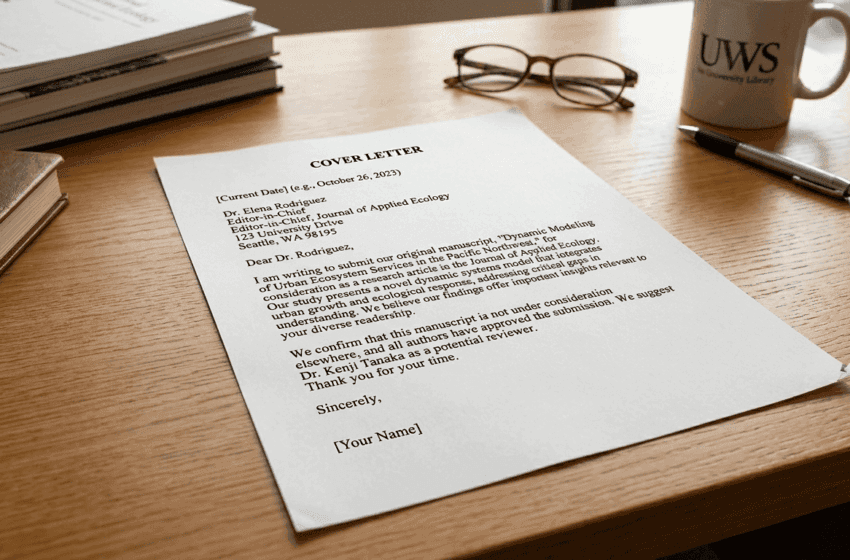
A journal submission cover letter is a formal one-page document addressed to the editor of an academic journal. It accompanies a manuscript submission and states the paper's title, core argument, original contribution, and confirmation of ethical compliance. It is the researcher's case for why this journal should invest time in reviewing this paper.
The cover letter sits at the very end of the research process, after the paper is complete and before it enters peer review. Journals use it to make a rapid initial decision: does this submission fit our scope, and does it meet minimum standards? A paper that is technically strong but paired with a vague or generic cover letter risks desk rejection, meaning an editor declines it without sending it to reviewers at all.
For high school students submitting to journals that accept student research, such as those listed in our guide to top academic journals accepting high school research papers, the cover letter also serves an additional function. It establishes credibility. Editors know they are reading work from a younger researcher. A well-constructed cover letter demonstrates that the student understands academic norms and has produced work that deserves serious consideration.
How to write a cover letter when submitting to an academic journal: a step-by-step process for high school students
Step 1: Address the letter to the correct editor by name. Every journal lists its editor-in-chief and section editors on its website. Find the name of the editor who handles your subject area and address the letter directly to that person. Writing "Dear Editor" signals that you did not research the journal. Writing "Dear Dr. Chen" signals that you did. This takes five minutes and immediately separates your submission from the majority.
Step 2: State the title, paper type, and journal name in the first sentence. The opening line should read something like: "I am submitting the manuscript titled 'The Effect of Microplastic Concentration on Daphnia magna Reproduction Rates' as an original research article for consideration in the Journal of Undergraduate and High School Research." This gives the editor immediate orientation. Do not open with a compliment about the journal or a sentence about why you became interested in the topic. Editors do not need either.
Step 3: Write a two to three sentence summary of your paper's core argument and method. This is not the abstract. It is a plain-language statement of what you studied, how you studied it, and what you found. A weak version says: "This paper examines the impact of social media on mental health." A strong version says: "This paper examines whether daily Instagram use exceeding three hours correlates with increased anxiety scores in Grade 10 students, measured using the GAD-7 scale across a sample of 84 participants at two secondary schools in Ontario. Results indicate a statistically significant positive correlation at p less than 0.05." The strong version tells the editor exactly what was done and what was found. The weak version tells them almost nothing.
Step 4: State the original contribution in one sentence. This is the answer to the question: what does this paper add that existing research does not already cover? Your literature review should have identified this gap. Now state it directly. For example: "This study contributes the first controlled comparison of GAD-7 scores across usage levels in a Canadian secondary school population, a demographic underrepresented in existing social media and anxiety literature." If you are not sure how to articulate your gap clearly, revisit your literature review. Learning how to find credible academic sources and map the existing field is what makes this sentence possible.
Step 5: Confirm ethical compliance and conflicts of interest. Most journals require a statement that the research was conducted ethically and that no conflicts of interest exist. If your research involved human participants, state that informed consent was obtained. If it involved animal subjects, state the protocol followed. If neither applies, write: "This research did not involve human or animal subjects. The authors declare no conflicts of interest." Omitting this section is a common reason for desk rejection, particularly for student submissions.
Step 6: Close with a professional sign-off and your contact information. End with a single sentence offering to provide supplementary materials if requested, then sign off with your full name, institutional affiliation (your school), and email address. Do not include your age or grade unless the journal specifically requests it.
The single most common mistake students make at this stage is copying the abstract into the cover letter. The cover letter and the abstract serve different purposes. The abstract is a technical summary for readers. The cover letter is an argument addressed to an editor about why the paper belongs in that specific journal. They should not read the same.
Where most high school students get stuck with writing a journal cover letter
The first sticking point is articulating the original contribution. Students who have spent months on their research often struggle to compress what makes it new into one sentence. This happens because identifying a gap in the literature requires a deep understanding of what the existing research actually says, not just what it covers. Students who have read broadly but not analytically find this sentence nearly impossible to write with precision.
The second sticking point is matching the letter to the journal's scope. Different journals prioritise different things: methodological rigor, theoretical contribution, policy relevance, or interdisciplinary reach. A cover letter that does not reflect the journal's stated priorities reads as generic, even if the paper itself is strong. Students working alone rarely read enough issues of the target journal to understand its editorial preferences.
The third sticking point is tone calibration. Academic cover letters are formal but not stiff. They are confident but not overclaiming. Getting that register right without experience reading and writing in academic contexts is genuinely difficult.
A PhD mentor resolves all three of these problems directly. At the cover letter stage, a mentor who has published in peer-reviewed journals can read a draft and identify immediately whether the contribution statement is precise enough, whether the framing matches the journal's scope, and whether the tone reads as credible. This is not a skill that develops from reading guides. It develops from exposure to the process, which is exactly what RISE Research PhD mentors bring to every scholar's submission.
If you are at this stage and want a PhD mentor to guide you through writing your cover letter and the full submission process, book a free 20-minute Research Assessment to see what is possible before the Summer 2026 Cohort I Deadline.
What does a good journal submission cover letter look like? A high school example
A strong cover letter for a high school journal submission is specific, confident, and brief. It names the journal, states the paper's argument and method in two sentences, identifies the gap the paper fills, confirms ethical compliance, and closes professionally. A weak cover letter is vague about the research, generic about the journal, and reads as if it could accompany any paper submitted anywhere.
Here is a weak opening paragraph:
"I am a high school student who has always been passionate about environmental science. I have written a research paper about microplastics and I think it would be a good fit for your journal because it covers an important topic that many people care about."
Here is a strong version of the same opening:
"I am submitting the manuscript titled 'Microplastic Concentration in Urban Stormwater Runoff and Its Effect on Daphnia magna Reproduction Rates' as an original research article for consideration in the Journal of High School Science. This study presents results from a controlled laboratory experiment measuring reproductive output in Daphnia magna populations exposed to four concentrations of polyethylene microplastics collected from stormwater samples in Toronto, Canada. Existing literature documents microplastic toxicity in marine organisms but provides limited data on freshwater zooplankton at environmentally realistic exposure levels. This study addresses that gap."
The strong version tells the editor the exact title, the method, the organism studied, the location, the gap in the literature, and the contribution, all in four sentences. The weak version tells the editor almost nothing except that the student is enthusiastic. Enthusiasm is not a reason to send a paper to peer review. Evidence of original, rigorous work is.
You can see the standard of published work that RISE Research scholars produce by reviewing the RISE publications page.
The best tools for writing a journal cover letter as a high school student
Google Scholar is the most useful starting point for verifying your contribution claim. Before writing the sentence that states what your paper adds, search your specific topic and filter results by the last three years. If you find a paper that already addresses your exact question, you need to refine your contribution statement, not abandon it. Knowing what exists is what makes your gap credible.
The journal's own author guidelines page is essential reading before you write a single word of the cover letter. Every journal publishes submission requirements, and many specify exactly what the cover letter must include. Some require a statement about prior publication. Others require suggested reviewers. Ignoring the author guidelines is the fastest route to desk rejection.
Zotero is a free reference manager that helps you organise the sources you cited in your paper. When writing the cover letter's contribution statement, having your sources organised by theme makes it easier to identify precisely where the gap in the literature sits. If you are still building your source library, the guide on how to read an academic paper when you have no research experience is a practical starting point.
Grammarly is useful for a final pass on tone and grammar, but it does not catch academic register errors. A sentence can be grammatically correct and still read as informal or overclaiming in an academic context. Use it as a proofreading tool, not a writing tool.
The RISE Research research blog covers multiple stages of the academic writing process, including source evaluation and bias detection, which are directly relevant to the contribution statement you need to write.
Frequently asked questions about writing a journal cover letter for high school students
How long should a cover letter for journal submission be?
A journal submission cover letter should be between 250 and 400 words, fitting on a single page. It must include the paper title, a brief summary of the research, the original contribution, an ethical compliance statement, and a professional close. Editors read many submissions. A letter that exceeds one page signals that the researcher has not made clear decisions about what matters most.
Do high school students need a cover letter when submitting to academic journals?
Yes. Every journal that accepts manuscript submissions requires a cover letter, regardless of the author's age or institutional affiliation. For high school students, the cover letter is especially important because it establishes credibility before the editor reads the paper. A well-written cover letter demonstrates that the student understands academic publishing norms and has produced work that merits serious review. Journals that publish student research, such as those listed in the top academic journals accepting high school research papers guide, still require a standard cover letter.
What should I include in a journal cover letter as a high school student?
Include the manuscript title and paper type, the journal name, a two to three sentence summary of your research question, method, and findings, a one sentence statement of your original contribution, an ethical compliance and conflict of interest statement, and your contact information and school affiliation. Do not include your grade level, age, or personal background unless the journal specifically requests it. The letter should read as a professional academic submission, not a student application.
Can I use the same cover letter for multiple journal submissions?
No. Each cover letter must be written specifically for the journal you are submitting to. The letter must name the journal, reference its scope, and explain why your paper fits that specific publication. A generic letter that does not mention the journal by name, or that could apply to any journal, signals to editors that the submission is not targeted and may not meet their scope. Reusing a cover letter verbatim is one of the most common reasons student submissions are rejected without review.
What is a desk rejection and how does a cover letter prevent it?
A desk rejection is when an editor declines a manuscript without sending it to peer reviewers. It happens when the paper does not fit the journal's scope, when the cover letter is incomplete, or when the submission does not meet basic formatting or ethical requirements. A precise cover letter prevents desk rejection by demonstrating scope fit, methodological credibility, and ethical compliance before the editor reads the paper itself. Most desk rejections at the student level are preventable with a well-structured cover letter.
Conclusion
Writing a strong cover letter when submitting to an academic journal comes down to three things: knowing your paper's contribution well enough to state it in one sentence, knowing the journal well enough to make the case for fit, and meeting every formal requirement the journal specifies. These are learnable skills, but they require familiarity with academic publishing that most high school students are still building.
The cover letter is also the document that reflects the quality of everything that came before it. If your research question is precise, your methodology is sound, and your literature review identifies a real gap, the cover letter writes itself. If any of those foundations are weak, the cover letter exposes it. RISE Research scholars develop all of these skills under the guidance of PhD mentors who have navigated this process across dozens of successful journal publications. The results speak directly: RISE scholars achieve a 90% publication success rate. You can review full admissions and publication outcomes on the RISE results page.
The Summer 2026 Cohort I Deadline is approaching. If writing a journal cover letter is a step you want to get right with expert guidance behind you, schedule a free Research Assessment and we will match you with a PhD mentor who has done this in your subject area.
TL;DR: A cover letter for journal submission is a one-page document that introduces your research paper to the editors of an academic journal. It tells them what your paper argues, why it belongs in their journal, and why it is ready for review. For high school students publishing original research, a strong cover letter is the first filter between your work and peer review. This guide explains exactly what to include, what to avoid, and how to write one that gets your paper taken seriously.
Introduction
Most high school students think a cover letter for journal submission is a formality, something like a polite email introducing a document. It is not. Knowing how to write a cover letter when submitting to an academic journal is one of the most underestimated skills in the entire research process. Editors at academic journals receive hundreds of submissions. The cover letter is what they read first, and it shapes how they read everything that follows.
A weak cover letter signals that a researcher does not understand the journal, the field, or the stakes of the submission. A strong one demonstrates exactly the opposite. It positions your research as relevant, original, and ready for scrutiny. For high school students who have completed original research, this is the document that determines whether your work reaches peer review or gets desk-rejected before anyone reads the abstract.
This guide gives you a precise, step-by-step process for writing a cover letter that meets the standards of academic journals that publish high school research.
What is a journal submission cover letter and why does it matter for your research paper?
A journal submission cover letter is a formal one-page document addressed to the editor of an academic journal. It accompanies a manuscript submission and states the paper's title, core argument, original contribution, and confirmation of ethical compliance. It is the researcher's case for why this journal should invest time in reviewing this paper.
The cover letter sits at the very end of the research process, after the paper is complete and before it enters peer review. Journals use it to make a rapid initial decision: does this submission fit our scope, and does it meet minimum standards? A paper that is technically strong but paired with a vague or generic cover letter risks desk rejection, meaning an editor declines it without sending it to reviewers at all.
For high school students submitting to journals that accept student research, such as those listed in our guide to top academic journals accepting high school research papers, the cover letter also serves an additional function. It establishes credibility. Editors know they are reading work from a younger researcher. A well-constructed cover letter demonstrates that the student understands academic norms and has produced work that deserves serious consideration.
How to write a cover letter when submitting to an academic journal: a step-by-step process for high school students
Step 1: Address the letter to the correct editor by name. Every journal lists its editor-in-chief and section editors on its website. Find the name of the editor who handles your subject area and address the letter directly to that person. Writing "Dear Editor" signals that you did not research the journal. Writing "Dear Dr. Chen" signals that you did. This takes five minutes and immediately separates your submission from the majority.
Step 2: State the title, paper type, and journal name in the first sentence. The opening line should read something like: "I am submitting the manuscript titled 'The Effect of Microplastic Concentration on Daphnia magna Reproduction Rates' as an original research article for consideration in the Journal of Undergraduate and High School Research." This gives the editor immediate orientation. Do not open with a compliment about the journal or a sentence about why you became interested in the topic. Editors do not need either.
Step 3: Write a two to three sentence summary of your paper's core argument and method. This is not the abstract. It is a plain-language statement of what you studied, how you studied it, and what you found. A weak version says: "This paper examines the impact of social media on mental health." A strong version says: "This paper examines whether daily Instagram use exceeding three hours correlates with increased anxiety scores in Grade 10 students, measured using the GAD-7 scale across a sample of 84 participants at two secondary schools in Ontario. Results indicate a statistically significant positive correlation at p less than 0.05." The strong version tells the editor exactly what was done and what was found. The weak version tells them almost nothing.
Step 4: State the original contribution in one sentence. This is the answer to the question: what does this paper add that existing research does not already cover? Your literature review should have identified this gap. Now state it directly. For example: "This study contributes the first controlled comparison of GAD-7 scores across usage levels in a Canadian secondary school population, a demographic underrepresented in existing social media and anxiety literature." If you are not sure how to articulate your gap clearly, revisit your literature review. Learning how to find credible academic sources and map the existing field is what makes this sentence possible.
Step 5: Confirm ethical compliance and conflicts of interest. Most journals require a statement that the research was conducted ethically and that no conflicts of interest exist. If your research involved human participants, state that informed consent was obtained. If it involved animal subjects, state the protocol followed. If neither applies, write: "This research did not involve human or animal subjects. The authors declare no conflicts of interest." Omitting this section is a common reason for desk rejection, particularly for student submissions.
Step 6: Close with a professional sign-off and your contact information. End with a single sentence offering to provide supplementary materials if requested, then sign off with your full name, institutional affiliation (your school), and email address. Do not include your age or grade unless the journal specifically requests it.
The single most common mistake students make at this stage is copying the abstract into the cover letter. The cover letter and the abstract serve different purposes. The abstract is a technical summary for readers. The cover letter is an argument addressed to an editor about why the paper belongs in that specific journal. They should not read the same.
Where most high school students get stuck with writing a journal cover letter
The first sticking point is articulating the original contribution. Students who have spent months on their research often struggle to compress what makes it new into one sentence. This happens because identifying a gap in the literature requires a deep understanding of what the existing research actually says, not just what it covers. Students who have read broadly but not analytically find this sentence nearly impossible to write with precision.
The second sticking point is matching the letter to the journal's scope. Different journals prioritise different things: methodological rigor, theoretical contribution, policy relevance, or interdisciplinary reach. A cover letter that does not reflect the journal's stated priorities reads as generic, even if the paper itself is strong. Students working alone rarely read enough issues of the target journal to understand its editorial preferences.
The third sticking point is tone calibration. Academic cover letters are formal but not stiff. They are confident but not overclaiming. Getting that register right without experience reading and writing in academic contexts is genuinely difficult.
A PhD mentor resolves all three of these problems directly. At the cover letter stage, a mentor who has published in peer-reviewed journals can read a draft and identify immediately whether the contribution statement is precise enough, whether the framing matches the journal's scope, and whether the tone reads as credible. This is not a skill that develops from reading guides. It develops from exposure to the process, which is exactly what RISE Research PhD mentors bring to every scholar's submission.
If you are at this stage and want a PhD mentor to guide you through writing your cover letter and the full submission process, book a free 20-minute Research Assessment to see what is possible before the Summer 2026 Cohort I Deadline.
What does a good journal submission cover letter look like? A high school example
A strong cover letter for a high school journal submission is specific, confident, and brief. It names the journal, states the paper's argument and method in two sentences, identifies the gap the paper fills, confirms ethical compliance, and closes professionally. A weak cover letter is vague about the research, generic about the journal, and reads as if it could accompany any paper submitted anywhere.
Here is a weak opening paragraph:
"I am a high school student who has always been passionate about environmental science. I have written a research paper about microplastics and I think it would be a good fit for your journal because it covers an important topic that many people care about."
Here is a strong version of the same opening:
"I am submitting the manuscript titled 'Microplastic Concentration in Urban Stormwater Runoff and Its Effect on Daphnia magna Reproduction Rates' as an original research article for consideration in the Journal of High School Science. This study presents results from a controlled laboratory experiment measuring reproductive output in Daphnia magna populations exposed to four concentrations of polyethylene microplastics collected from stormwater samples in Toronto, Canada. Existing literature documents microplastic toxicity in marine organisms but provides limited data on freshwater zooplankton at environmentally realistic exposure levels. This study addresses that gap."
The strong version tells the editor the exact title, the method, the organism studied, the location, the gap in the literature, and the contribution, all in four sentences. The weak version tells the editor almost nothing except that the student is enthusiastic. Enthusiasm is not a reason to send a paper to peer review. Evidence of original, rigorous work is.
You can see the standard of published work that RISE Research scholars produce by reviewing the RISE publications page.
The best tools for writing a journal cover letter as a high school student
Google Scholar is the most useful starting point for verifying your contribution claim. Before writing the sentence that states what your paper adds, search your specific topic and filter results by the last three years. If you find a paper that already addresses your exact question, you need to refine your contribution statement, not abandon it. Knowing what exists is what makes your gap credible.
The journal's own author guidelines page is essential reading before you write a single word of the cover letter. Every journal publishes submission requirements, and many specify exactly what the cover letter must include. Some require a statement about prior publication. Others require suggested reviewers. Ignoring the author guidelines is the fastest route to desk rejection.
Zotero is a free reference manager that helps you organise the sources you cited in your paper. When writing the cover letter's contribution statement, having your sources organised by theme makes it easier to identify precisely where the gap in the literature sits. If you are still building your source library, the guide on how to read an academic paper when you have no research experience is a practical starting point.
Grammarly is useful for a final pass on tone and grammar, but it does not catch academic register errors. A sentence can be grammatically correct and still read as informal or overclaiming in an academic context. Use it as a proofreading tool, not a writing tool.
The RISE Research research blog covers multiple stages of the academic writing process, including source evaluation and bias detection, which are directly relevant to the contribution statement you need to write.
Frequently asked questions about writing a journal cover letter for high school students
How long should a cover letter for journal submission be?
A journal submission cover letter should be between 250 and 400 words, fitting on a single page. It must include the paper title, a brief summary of the research, the original contribution, an ethical compliance statement, and a professional close. Editors read many submissions. A letter that exceeds one page signals that the researcher has not made clear decisions about what matters most.
Do high school students need a cover letter when submitting to academic journals?
Yes. Every journal that accepts manuscript submissions requires a cover letter, regardless of the author's age or institutional affiliation. For high school students, the cover letter is especially important because it establishes credibility before the editor reads the paper. A well-written cover letter demonstrates that the student understands academic publishing norms and has produced work that merits serious review. Journals that publish student research, such as those listed in the top academic journals accepting high school research papers guide, still require a standard cover letter.
What should I include in a journal cover letter as a high school student?
Include the manuscript title and paper type, the journal name, a two to three sentence summary of your research question, method, and findings, a one sentence statement of your original contribution, an ethical compliance and conflict of interest statement, and your contact information and school affiliation. Do not include your grade level, age, or personal background unless the journal specifically requests it. The letter should read as a professional academic submission, not a student application.
Can I use the same cover letter for multiple journal submissions?
No. Each cover letter must be written specifically for the journal you are submitting to. The letter must name the journal, reference its scope, and explain why your paper fits that specific publication. A generic letter that does not mention the journal by name, or that could apply to any journal, signals to editors that the submission is not targeted and may not meet their scope. Reusing a cover letter verbatim is one of the most common reasons student submissions are rejected without review.
What is a desk rejection and how does a cover letter prevent it?
A desk rejection is when an editor declines a manuscript without sending it to peer reviewers. It happens when the paper does not fit the journal's scope, when the cover letter is incomplete, or when the submission does not meet basic formatting or ethical requirements. A precise cover letter prevents desk rejection by demonstrating scope fit, methodological credibility, and ethical compliance before the editor reads the paper itself. Most desk rejections at the student level are preventable with a well-structured cover letter.
Conclusion
Writing a strong cover letter when submitting to an academic journal comes down to three things: knowing your paper's contribution well enough to state it in one sentence, knowing the journal well enough to make the case for fit, and meeting every formal requirement the journal specifies. These are learnable skills, but they require familiarity with academic publishing that most high school students are still building.
The cover letter is also the document that reflects the quality of everything that came before it. If your research question is precise, your methodology is sound, and your literature review identifies a real gap, the cover letter writes itself. If any of those foundations are weak, the cover letter exposes it. RISE Research scholars develop all of these skills under the guidance of PhD mentors who have navigated this process across dozens of successful journal publications. The results speak directly: RISE scholars achieve a 90% publication success rate. You can review full admissions and publication outcomes on the RISE results page.
The Summer 2026 Cohort I Deadline is approaching. If writing a journal cover letter is a step you want to get right with expert guidance behind you, schedule a free Research Assessment and we will match you with a PhD mentor who has done this in your subject area.
Winter 2026 Early Admission Deadline Closing on 18th October
Book a free 20-min strategy call
Book a free 20-min strategy call
Read More