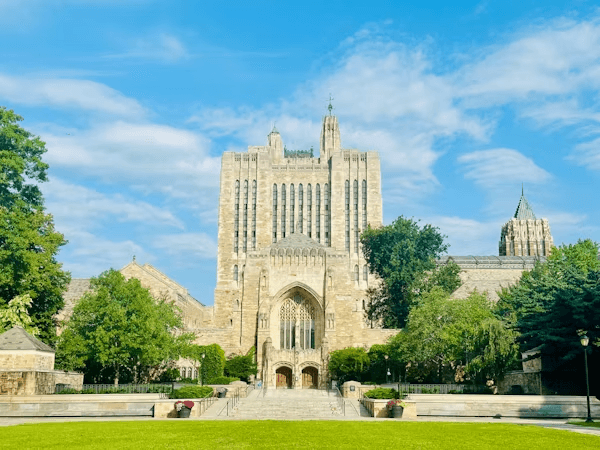
How to get into Yale with research | RISE Research
How to get into Yale with research | RISE Research
RISE Research
RISE Research
TL;DR: Yale's overall acceptance rate sits at 3.7% for the Class of 2028, making it one of the most selective universities in the world. High school research does not guarantee admission, but it is one of the clearest signals of the intellectual initiative Yale explicitly values. RISE Scholars who apply to Yale carry published research and PhD mentor endorsements into their applications. If Yale is your target, the time to start building that research record is now, not in Grade 12.
Introduction
Your child has a 4.0 GPA and a 1550 SAT score. So does nearly every other student applying to Yale this year. Yale's acceptance rate for the Class of 2028 was 3.7%, meaning Yale rejected more than 96 out of every 100 applicants. Grades and scores are the floor, not the ceiling. What separates admitted students is evidence of genuine intellectual initiative, the kind that goes beyond classroom performance and into original, independent work. This post covers exactly how high school research factors into Yale admissions, what Yale's own admissions materials say about it, and how students can use published research to build the strongest possible application.
Does Research Experience Help You Get Into Yale?
Answer: Yes, and the data is specific. Yale's admissions office explicitly evaluates applicants on intellectual curiosity and independent academic initiative. Students who enter the Yale application process with published research demonstrate a level of scholarly engagement that coursework alone cannot replicate. RISE Scholars report a 3x higher acceptance rate to Top 10 universities compared to the general applicant pool.
Yale does not use a point-based admissions rubric. Instead, admissions officers evaluate each applicant holistically across several dimensions, including academic excellence, personal character, and demonstrated intellectual engagement outside the classroom. Research sits at the intersection of all three. A student who identified a genuine question, worked with a PhD mentor to investigate it, and published findings in a peer-reviewed journal has done something most applicants have not. That distinction registers.
The difference between research that helps and research that does not comes down to depth and authenticity. A summer programme certificate from a university campus, where a student attended lectures and completed a group project, does not carry the same weight as a sole-authored or co-authored paper accepted by a peer-reviewed journal. Yale admissions officers read thousands of applications from students who attended prestigious summer programmes. They read far fewer from students who produced original findings under a PhD mentor and submitted them for peer review. That gap is where research becomes a genuine differentiator in the Yale application.
What Yale Admissions Officers Say About Intellectual Curiosity and Independent Work
Yale's admissions office has been direct about what it values beyond grades. In Yale's official admissions guidance, the university states that it seeks students who demonstrate "a passion for learning and a desire to make a difference." Yale describes its ideal applicant as someone who pursues intellectual interests with depth and commitment, not breadth alone.
Yale's former Dean of Admissions, Jeremiah Quinlan, has noted in published interviews that Yale looks for students who take intellectual risks. Pursuing a research question that has no guaranteed answer, submitting work to peer review, and revising based on expert feedback are all forms of intellectual risk-taking that coursework rarely demands.
Yale's supplemental essays reinforce this signal. The prompt asking applicants to describe "a topic, idea, or concept you find so engaging it makes you lose track of time" is a direct invitation to write about research. A student who can point to a published paper as the evidence behind their answer is giving Yale exactly what the prompt is designed to surface: genuine, sustained intellectual engagement. Vague enthusiasm does not satisfy this prompt. A documented research journey does.
What this means practically: published research gives a student concrete, verifiable material to anchor their Yale essays. It transforms abstract claims about intellectual passion into a documented record that admissions officers can assess independently.
What Kind of Research Actually Impresses Yale Admissions?
Answer: Yale responds to research that is original, independently driven, and documented through peer review or formal publication. The subject matters less than the depth. A student who spent eight months investigating a specific question in economics, psychology, or environmental science and produced a publishable paper demonstrates more than a student who completed a structured university summer course in the same field.
The subjects that align most naturally with Yale's academic culture and the research areas where RISE Scholars produce strong work include social sciences, public health, economics and policy, and the humanities. Yale places particular emphasis on interdisciplinary thinking, so research that crosses subject boundaries, such as a project examining the economic impact of a public health intervention, tends to resonate strongly with Yale's admissions priorities.
On the Yale application specifically, the supplemental essay prompts offer two primary opportunities to present research. The first is the intellectual engagement prompt described above. The second is the "Why Yale" essay, where a student can connect their research interests to specific Yale faculty, labs, or academic programmes. A student who has already published research in a related field can name the Yale professor whose work connects to their own and explain what they would bring to that intellectual community. That level of specificity is rare and memorable.
The Common App additional information section is also valuable. Use it to list the journal name, publication date, and a one-sentence description of the research question. Do not use it to reproduce the abstract. Keep it factual and brief. Admissions officers appreciate clarity over elaboration in this section.
For guidance on how to get research published before your Yale application, the RISE Publications page outlines the journals where RISE Scholars have successfully placed their work.
How Students Can Use Research to Get Into Yale
There are several ways a student can build a research record that strengthens a Yale application. The most effective approach combines original research, expert mentorship, formal publication, and strategic essay writing.
The first path is working directly with a PhD mentor to develop and execute an original research project. This is the approach RISE Research is built around. Each RISE Scholar is matched with a PhD mentor from an Ivy League or Oxbridge institution who guides the student through every stage: forming a research question, reviewing existing literature, collecting and analysing data, and preparing a manuscript for peer-reviewed publication. The result is a completed paper, not a certificate of participation. RISE's mentor network includes over 500 PhD researchers published across 40 or more academic journals.
The second path involves connecting research to Yale's specific academic offerings. Once a student has a published or in-review paper, they can identify Yale faculty working in adjacent areas and reference those connections in the "Why Yale" supplemental essay. This transforms the research from a standalone achievement into a demonstration of fit with Yale's intellectual community.
A third path is using the research process itself as material for the personal statement. The challenges of forming a hypothesis, encountering unexpected results, and revising conclusions under expert guidance provide exactly the kind of narrative arc that makes a personal statement compelling and specific. Students who have gone through this process with a RISE mentor consistently report that writing their personal statement became significantly easier because they had a real story to tell. You can explore examples of the kinds of projects RISE Scholars pursue on the RISE Projects page.
For students who want to understand how other high school researchers have navigated the publication process, the guide on how to publish high school research without a university affiliation is a practical starting point.
When Should You Start Research if Yale Is Your Goal?
The timeline matters more than most students and parents realise. Here is how it maps across high school.
In Grades 9 and 10, the priority is subject exploration. Students should identify the areas where their intellectual curiosity is strongest, read broadly, and begin to notice the questions that do not yet have clear answers. This is not the time to start a formal research project. It is the time to build the intellectual foundation that will make a research question feel authentic rather than manufactured.
Grades 10 and 11 represent the optimal window for Yale applicants. This is when a student should begin the RISE programme, develop a focused research question with their PhD mentor, conduct the research, and prepare a manuscript for submission. Starting in Grade 10 or early Grade 11 allows the paper to move through peer review and reach publication, or at minimum receive a formal acceptance, before Yale applications open in September of Grade 12.
The summer between Grades 11 and 12 is the target submission window. A paper submitted in June or July of that summer can reasonably expect a peer-review decision by September or October, which is exactly when Yale supplemental essays are being written. A paper under review at a recognised journal is reportable on the Common App and in Yale's additional information section. A published paper is stronger still.
In Grade 12, from September through November, the research becomes the engine of the application. The Yale supplemental essays, the personal statement, and the additional information section all draw from the same source: the documented research experience. Students who have completed their research by this point are writing from a position of strength. Those who are still in the early stages of a project are working against the clock.
Starting in Grade 12 is still possible. RISE does work with Grade 12 students. But the options narrow. A paper begun in September of Grade 12 is unlikely to be published before Yale's Regular Decision deadline in January. It may be under review, which is reportable but carries less weight than a published paper. The honest advice is this: the earlier a student starts, the more the research can do for the application. Grade 11 is good. Grade 10 is better.
For more on how students without access to school-based research resources can still build a strong record, see research programmes for high schoolers without strong school resources.
The Summer 2026 cohort is approaching soon. If Yale is on your list and your child wants research to be part of their application, book a free 20-minute Research Assessment to find out what is realistic in your timeline.
Frequently Asked Questions About Research and Yale Admissions
Does Yale require research experience for admission?
Yale does not require research experience. No Ivy League university lists research as a mandatory component of the application. However, Yale's admissions materials consistently describe intellectual initiative and independent inquiry as among the qualities it values most. Research is one of the clearest ways to demonstrate those qualities. Students without research experience are not automatically disadvantaged, but students with published research carry a concrete, verifiable signal that most applicants cannot match.
Does a published paper make a real difference compared to just doing research?
Yes. A published paper demonstrates that the student's work met an external standard of quality through peer review. Participation in a research project, without a published output, is harder to verify and easier to dismiss as supervised coursework. A paper accepted by a peer-reviewed journal is an independent credential. Yale admissions officers can look it up, read it, and assess its quality. That verification matters in a process where self-reported achievements are common and external validation is rare. RISE maintains a 90% publication success rate across its scholar cohorts.
What subjects are most valued at Yale for research applicants?
Yale does not rank subjects in its admissions criteria. Strong research in any field can support a Yale application if the work is original and rigorously conducted. That said, Yale's academic culture places particular emphasis on interdisciplinary inquiry, public service, and humanistic values alongside scientific rigour. Research in social sciences, public health, economics, environmental studies, and the humanities tends to align well with Yale's stated priorities. RISE Scholars have published successfully across all of these areas. You can view subject examples on the RISE Projects page.
How do I write about research in Yale's supplemental essays?
Yale's supplemental essay asking about a topic that makes you lose track of time is the primary vehicle for presenting research. Do not summarise the paper. Instead, describe the moment the question first appeared, what it felt like to pursue it without a guaranteed answer, and what you learned about how you think. Use the paper as evidence, not as the subject. In the "Why Yale" essay, connect your research interests to specific Yale faculty, courses, or programmes. Name the professor. Name the lab. Show that you have read their work and can explain why your own research points toward their intellectual community.
Is it too late to do research in Grade 12 for a Yale application?
It is not too late, but the options are more limited. A research project begun in Grade 12 September is unlikely to reach publication before Yale's January Regular Decision deadline. The paper may be under review by then, which is reportable and does carry weight. If you are in Grade 12 and Yale is your target, the priority is to start immediately, move quickly through the research question and literature review stages, and submit to a journal as early as possible. RISE works with Grade 12 students in this situation. A consultation will clarify what is achievable in your specific timeline.
Conclusion
Yale's 3.7% acceptance rate means the application process rewards differentiation. Grades and scores qualify a student for consideration. Published research, conducted under a PhD mentor and documented through peer review, is one of the most credible forms of differentiation available to a high school student. It generates material for essays, demonstrates intellectual initiative in a verifiable way, and signals the kind of independent thinking Yale describes in its own admissions materials. The students who use research most effectively start early, choose questions they genuinely care about, and work with mentors who hold them to rigorous academic standards. That is exactly what RISE Research is designed to produce. The Summer 2026 Priority Deadline is approaching soon. If Yale is your target and you want research to be a real part of your application, schedule a free Research Assessment and we will tell you exactly what is achievable in your timeline.
TL;DR: Yale's overall acceptance rate sits at 3.7% for the Class of 2028, making it one of the most selective universities in the world. High school research does not guarantee admission, but it is one of the clearest signals of the intellectual initiative Yale explicitly values. RISE Scholars who apply to Yale carry published research and PhD mentor endorsements into their applications. If Yale is your target, the time to start building that research record is now, not in Grade 12.
Introduction
Your child has a 4.0 GPA and a 1550 SAT score. So does nearly every other student applying to Yale this year. Yale's acceptance rate for the Class of 2028 was 3.7%, meaning Yale rejected more than 96 out of every 100 applicants. Grades and scores are the floor, not the ceiling. What separates admitted students is evidence of genuine intellectual initiative, the kind that goes beyond classroom performance and into original, independent work. This post covers exactly how high school research factors into Yale admissions, what Yale's own admissions materials say about it, and how students can use published research to build the strongest possible application.
Does Research Experience Help You Get Into Yale?
Answer: Yes, and the data is specific. Yale's admissions office explicitly evaluates applicants on intellectual curiosity and independent academic initiative. Students who enter the Yale application process with published research demonstrate a level of scholarly engagement that coursework alone cannot replicate. RISE Scholars report a 3x higher acceptance rate to Top 10 universities compared to the general applicant pool.
Yale does not use a point-based admissions rubric. Instead, admissions officers evaluate each applicant holistically across several dimensions, including academic excellence, personal character, and demonstrated intellectual engagement outside the classroom. Research sits at the intersection of all three. A student who identified a genuine question, worked with a PhD mentor to investigate it, and published findings in a peer-reviewed journal has done something most applicants have not. That distinction registers.
The difference between research that helps and research that does not comes down to depth and authenticity. A summer programme certificate from a university campus, where a student attended lectures and completed a group project, does not carry the same weight as a sole-authored or co-authored paper accepted by a peer-reviewed journal. Yale admissions officers read thousands of applications from students who attended prestigious summer programmes. They read far fewer from students who produced original findings under a PhD mentor and submitted them for peer review. That gap is where research becomes a genuine differentiator in the Yale application.
What Yale Admissions Officers Say About Intellectual Curiosity and Independent Work
Yale's admissions office has been direct about what it values beyond grades. In Yale's official admissions guidance, the university states that it seeks students who demonstrate "a passion for learning and a desire to make a difference." Yale describes its ideal applicant as someone who pursues intellectual interests with depth and commitment, not breadth alone.
Yale's former Dean of Admissions, Jeremiah Quinlan, has noted in published interviews that Yale looks for students who take intellectual risks. Pursuing a research question that has no guaranteed answer, submitting work to peer review, and revising based on expert feedback are all forms of intellectual risk-taking that coursework rarely demands.
Yale's supplemental essays reinforce this signal. The prompt asking applicants to describe "a topic, idea, or concept you find so engaging it makes you lose track of time" is a direct invitation to write about research. A student who can point to a published paper as the evidence behind their answer is giving Yale exactly what the prompt is designed to surface: genuine, sustained intellectual engagement. Vague enthusiasm does not satisfy this prompt. A documented research journey does.
What this means practically: published research gives a student concrete, verifiable material to anchor their Yale essays. It transforms abstract claims about intellectual passion into a documented record that admissions officers can assess independently.
What Kind of Research Actually Impresses Yale Admissions?
Answer: Yale responds to research that is original, independently driven, and documented through peer review or formal publication. The subject matters less than the depth. A student who spent eight months investigating a specific question in economics, psychology, or environmental science and produced a publishable paper demonstrates more than a student who completed a structured university summer course in the same field.
The subjects that align most naturally with Yale's academic culture and the research areas where RISE Scholars produce strong work include social sciences, public health, economics and policy, and the humanities. Yale places particular emphasis on interdisciplinary thinking, so research that crosses subject boundaries, such as a project examining the economic impact of a public health intervention, tends to resonate strongly with Yale's admissions priorities.
On the Yale application specifically, the supplemental essay prompts offer two primary opportunities to present research. The first is the intellectual engagement prompt described above. The second is the "Why Yale" essay, where a student can connect their research interests to specific Yale faculty, labs, or academic programmes. A student who has already published research in a related field can name the Yale professor whose work connects to their own and explain what they would bring to that intellectual community. That level of specificity is rare and memorable.
The Common App additional information section is also valuable. Use it to list the journal name, publication date, and a one-sentence description of the research question. Do not use it to reproduce the abstract. Keep it factual and brief. Admissions officers appreciate clarity over elaboration in this section.
For guidance on how to get research published before your Yale application, the RISE Publications page outlines the journals where RISE Scholars have successfully placed their work.
How Students Can Use Research to Get Into Yale
There are several ways a student can build a research record that strengthens a Yale application. The most effective approach combines original research, expert mentorship, formal publication, and strategic essay writing.
The first path is working directly with a PhD mentor to develop and execute an original research project. This is the approach RISE Research is built around. Each RISE Scholar is matched with a PhD mentor from an Ivy League or Oxbridge institution who guides the student through every stage: forming a research question, reviewing existing literature, collecting and analysing data, and preparing a manuscript for peer-reviewed publication. The result is a completed paper, not a certificate of participation. RISE's mentor network includes over 500 PhD researchers published across 40 or more academic journals.
The second path involves connecting research to Yale's specific academic offerings. Once a student has a published or in-review paper, they can identify Yale faculty working in adjacent areas and reference those connections in the "Why Yale" supplemental essay. This transforms the research from a standalone achievement into a demonstration of fit with Yale's intellectual community.
A third path is using the research process itself as material for the personal statement. The challenges of forming a hypothesis, encountering unexpected results, and revising conclusions under expert guidance provide exactly the kind of narrative arc that makes a personal statement compelling and specific. Students who have gone through this process with a RISE mentor consistently report that writing their personal statement became significantly easier because they had a real story to tell. You can explore examples of the kinds of projects RISE Scholars pursue on the RISE Projects page.
For students who want to understand how other high school researchers have navigated the publication process, the guide on how to publish high school research without a university affiliation is a practical starting point.
When Should You Start Research if Yale Is Your Goal?
The timeline matters more than most students and parents realise. Here is how it maps across high school.
In Grades 9 and 10, the priority is subject exploration. Students should identify the areas where their intellectual curiosity is strongest, read broadly, and begin to notice the questions that do not yet have clear answers. This is not the time to start a formal research project. It is the time to build the intellectual foundation that will make a research question feel authentic rather than manufactured.
Grades 10 and 11 represent the optimal window for Yale applicants. This is when a student should begin the RISE programme, develop a focused research question with their PhD mentor, conduct the research, and prepare a manuscript for submission. Starting in Grade 10 or early Grade 11 allows the paper to move through peer review and reach publication, or at minimum receive a formal acceptance, before Yale applications open in September of Grade 12.
The summer between Grades 11 and 12 is the target submission window. A paper submitted in June or July of that summer can reasonably expect a peer-review decision by September or October, which is exactly when Yale supplemental essays are being written. A paper under review at a recognised journal is reportable on the Common App and in Yale's additional information section. A published paper is stronger still.
In Grade 12, from September through November, the research becomes the engine of the application. The Yale supplemental essays, the personal statement, and the additional information section all draw from the same source: the documented research experience. Students who have completed their research by this point are writing from a position of strength. Those who are still in the early stages of a project are working against the clock.
Starting in Grade 12 is still possible. RISE does work with Grade 12 students. But the options narrow. A paper begun in September of Grade 12 is unlikely to be published before Yale's Regular Decision deadline in January. It may be under review, which is reportable but carries less weight than a published paper. The honest advice is this: the earlier a student starts, the more the research can do for the application. Grade 11 is good. Grade 10 is better.
For more on how students without access to school-based research resources can still build a strong record, see research programmes for high schoolers without strong school resources.
The Summer 2026 cohort is approaching soon. If Yale is on your list and your child wants research to be part of their application, book a free 20-minute Research Assessment to find out what is realistic in your timeline.
Frequently Asked Questions About Research and Yale Admissions
Does Yale require research experience for admission?
Yale does not require research experience. No Ivy League university lists research as a mandatory component of the application. However, Yale's admissions materials consistently describe intellectual initiative and independent inquiry as among the qualities it values most. Research is one of the clearest ways to demonstrate those qualities. Students without research experience are not automatically disadvantaged, but students with published research carry a concrete, verifiable signal that most applicants cannot match.
Does a published paper make a real difference compared to just doing research?
Yes. A published paper demonstrates that the student's work met an external standard of quality through peer review. Participation in a research project, without a published output, is harder to verify and easier to dismiss as supervised coursework. A paper accepted by a peer-reviewed journal is an independent credential. Yale admissions officers can look it up, read it, and assess its quality. That verification matters in a process where self-reported achievements are common and external validation is rare. RISE maintains a 90% publication success rate across its scholar cohorts.
What subjects are most valued at Yale for research applicants?
Yale does not rank subjects in its admissions criteria. Strong research in any field can support a Yale application if the work is original and rigorously conducted. That said, Yale's academic culture places particular emphasis on interdisciplinary inquiry, public service, and humanistic values alongside scientific rigour. Research in social sciences, public health, economics, environmental studies, and the humanities tends to align well with Yale's stated priorities. RISE Scholars have published successfully across all of these areas. You can view subject examples on the RISE Projects page.
How do I write about research in Yale's supplemental essays?
Yale's supplemental essay asking about a topic that makes you lose track of time is the primary vehicle for presenting research. Do not summarise the paper. Instead, describe the moment the question first appeared, what it felt like to pursue it without a guaranteed answer, and what you learned about how you think. Use the paper as evidence, not as the subject. In the "Why Yale" essay, connect your research interests to specific Yale faculty, courses, or programmes. Name the professor. Name the lab. Show that you have read their work and can explain why your own research points toward their intellectual community.
Is it too late to do research in Grade 12 for a Yale application?
It is not too late, but the options are more limited. A research project begun in Grade 12 September is unlikely to reach publication before Yale's January Regular Decision deadline. The paper may be under review by then, which is reportable and does carry weight. If you are in Grade 12 and Yale is your target, the priority is to start immediately, move quickly through the research question and literature review stages, and submit to a journal as early as possible. RISE works with Grade 12 students in this situation. A consultation will clarify what is achievable in your specific timeline.
Conclusion
Yale's 3.7% acceptance rate means the application process rewards differentiation. Grades and scores qualify a student for consideration. Published research, conducted under a PhD mentor and documented through peer review, is one of the most credible forms of differentiation available to a high school student. It generates material for essays, demonstrates intellectual initiative in a verifiable way, and signals the kind of independent thinking Yale describes in its own admissions materials. The students who use research most effectively start early, choose questions they genuinely care about, and work with mentors who hold them to rigorous academic standards. That is exactly what RISE Research is designed to produce. The Summer 2026 Priority Deadline is approaching soon. If Yale is your target and you want research to be a real part of your application, schedule a free Research Assessment and we will tell you exactly what is achievable in your timeline.
Fall 2026 Cohort Deadline Closing on 28th September
Book a free 20-min strategy call
Book a free 20-min strategy call
Read More