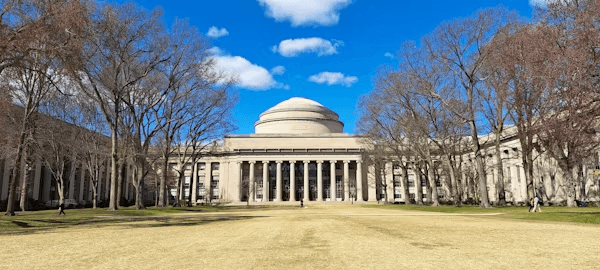
How to get into MIT with research | RISE Research
How to get into MIT with research | RISE Research
RISE Research
RISE Research
TL;DR: MIT's overall acceptance rate sits at 3.9% for the Class of 2028. For students who want to stand out, original research is one of the strongest signals available. MIT's admissions office explicitly values intellectual initiative and independent inquiry. RISE Scholars who apply to MIT do so with published papers, PhD mentor endorsements, and a documented research process. This post covers what MIT actually looks for, how research registers in the evaluation, and when to start if MIT is your target.
Your child has a 4.0 and a 1580. So does everyone else applying to MIT this year.
MIT received over 26,000 applications for the Class of 2028 and admitted just 3.9% of applicants. Among those rejected were thousands of students with perfect grades, near-perfect test scores, and strong extracurriculars. The question is not whether your child is academically capable. The question is whether their application shows MIT something that grades alone cannot: the ability to generate original knowledge, not just absorb it. This post explains exactly how high school research helps you get into MIT, what kind of research MIT actually notices, and how to build a research profile that holds up inside one of the most rigorous admissions processes in the world.
Does research experience help you get into MIT?
Answer: Yes, and MIT is one of the universities where research carries the most weight. MIT's admissions office explicitly evaluates applicants for evidence of intellectual initiative and independent problem-solving. A published paper or a supervised research project signals exactly that. RISE Scholars applying to MIT carry a 90% publication success rate into their applications, giving them a verifiable, third-party-validated record of original work.
MIT does not admit students who simply perform well in structured environments. Its admissions process is designed to find students who push past the curriculum on their own. The MIT admissions process evaluates five qualities: academic excellence, alignment with MIT's mission, collaboration, initiative, and impact. Research addresses at least three of these directly.
The difference between research that helps and research that does not comes down to depth and ownership. A student who completed a two-week summer programme and received a participation certificate has not done research in the way MIT defines it. A student who identified an original question, reviewed existing literature, collected or analysed data, and produced a written paper under a PhD mentor has. MIT's evaluators read thousands of applications. They recognise the difference immediately.
RISE Scholars who apply to MIT bring published work in peer-reviewed journals, letters of support from PhD mentors at institutions like Harvard, MIT, and Stanford, and supplemental essays built around a single, coherent intellectual narrative. That combination is rare. It is also exactly what MIT describes when it talks about the students it most wants to admit. You can explore RISE Scholar outcomes to see how this translates across top universities.
What MIT admissions officers say about intellectual curiosity and independent work
MIT's admissions office has been unusually direct about what it values. In a widely cited post on the MIT Admissions blog, Senior Admissions Officer Abby Abazorius wrote that MIT looks for students who are "doers" and who show "intensity of interest" in a specific domain. The post describes how officers distinguish between students who list activities and students who demonstrate genuine immersion in a subject.
MIT's own "What We Look For" page states that MIT values "the excitement of discovery" and students who "go beyond what is taught in class." This is not a vague aspiration. It is a direct description of what independent research produces: a student who encountered a real question, worked through uncertainty, and arrived at a conclusion that did not exist before they started.
MIT also uses a holistic review system in which academic evaluators, not just admissions readers, assess scientific and mathematical potential. For students applying to engineering, computer science, physics, or biology, a published paper reviewed by a subject-matter expert carries weight that a high grade in AP Physics simply cannot replicate. The paper shows the evaluator what the student does when no one is grading them.
Practically, this means that a student with a published paper in a peer-reviewed journal, or even a paper under review at the time of application, enters the academic evaluation with a concrete artefact. The evaluator does not have to infer intellectual potential from grades. The evidence is in the document itself.
What kind of research actually impresses MIT admissions?
Answer: MIT responds to research that is original, methodologically sound, and connected to a real intellectual question in science, engineering, mathematics, or technology. The research should result in a written paper, ideally published or submitted to a peer-reviewed journal. A supervised project with a PhD mentor and a clear research question is the minimum viable standard.
MIT applicants pursue research across a wide range of subjects, but the strongest alignment exists in four areas: computer science and artificial intelligence, physics and mathematics, biology and biomedical engineering, and environmental science. These align with MIT's own departmental strengths and with the problems MIT describes as central to its mission.
MIT's supplemental essays include a prompt asking students to describe how they have gone beyond their formal education to explore something they are passionate about. This is a direct invitation to write about research. The essay has a 200-word limit, which means every sentence must carry weight. A student who has published a paper can describe the question they asked, the method they used, and what they found. A student who attended a summer programme can only describe what they were taught.
The Common App additional information section is also important for MIT applicants with research experience. Use it to list the journal name, submission or publication date, the title of the paper, and the name and institution of the supervising mentor. Keep it factual. MIT evaluators will look it up. Make sure the information is accurate and verifiable. Students who want to understand the publication process in detail can read about how to publish high school research without a university affiliation.
How students can use research to get into MIT
There are several concrete ways that research strengthens an MIT application, and RISE is built to support each of them.
The first is the research paper itself. A published paper in a peer-reviewed journal gives MIT's academic evaluators something measurable. It shows that the student's work met an external standard. RISE Scholars publish in over 40 academic journals, and the programme carries a 90% publication success rate. You can browse RISE publication venues to see where scholars have placed their work.
The second is the mentor relationship. RISE pairs each student with a PhD mentor from an institution like MIT, Harvard, or Stanford. That mentor can write a letter of support that goes beyond a standard teacher recommendation. It describes the student's intellectual process, their ability to handle ambiguity, and their contribution to the research. This kind of letter is rare in a high school application and carries significant weight at MIT.
The third is the essay narrative. MIT's supplemental prompts reward students who can articulate a specific intellectual journey. A student who has completed original research has a natural, coherent story to tell: the question they identified, the challenge they faced, and what they learned. That narrative is far more compelling than a description of a club or a competition result. Students can explore RISE Scholar projects to see the range of topics students have researched.
The fourth is differentiation. MIT receives thousands of applications from students with strong STEM backgrounds. A published paper in computational biology or applied mathematics places a student in a much smaller group. RISE Research is designed to produce exactly that outcome: a student who arrives at MIT's application portal with original work already in the public record. You can also look at RISE Scholar awards to understand how research recognition compounds the admissions advantage.
When should you start research if MIT is your goal?
The timeline matters more than most students and parents realise. Here is how it maps across high school.
In Grades 9 and 10, the priority is subject exploration. Students should identify the area of science, mathematics, or technology that genuinely interests them, not the one that looks best on paper. MIT's evaluators can tell the difference between authentic curiosity and strategic positioning. Reading papers, following researchers on academic platforms, and taking advanced coursework are all useful at this stage.
Grades 10 and 11 represent the optimal window for beginning a RISE Research project. A student who starts in this period has time to develop a research question, conduct the work, write the paper, and submit it to a journal before Grade 12 applications open. The paper may be under review or already published by September of Grade 12, which is the strongest possible position for an MIT applicant.
The summer before Grade 12 is the critical submission window. If the paper is submitted to a journal by August, it is either published or under review when MIT's November early action deadline arrives. Both statuses are valuable. A paper under review at a peer-reviewed journal still demonstrates that the work met the threshold for external evaluation.
In September and October of Grade 12, the research becomes the foundation for MIT's supplemental essays. The "going beyond your formal education" prompt, the activities list, and the additional information section all draw directly from the research record the student has built. Students who want to understand how research fits into applications without a university lab can read about getting research experience without a lab.
Starting in Grade 12 is still possible. RISE has supported students who began research in the fall of their senior year and submitted strong applications. The limitation is time: a paper started in September is unlikely to be published by November. It may be under review, which is still useful, but the student will have less time to develop the essay narrative around it. Starting earlier is always better. Starting late is better than not starting at all.
The Summer 2026 cohort is approaching soon. If MIT is on your list and your child wants research to be part of their application, book a free 20-minute Research Assessment to find out what is realistic in your timeline.
Frequently asked questions about research and MIT admissions
Does MIT require research experience for admission?
MIT does not require research experience, but it strongly rewards it. MIT's admissions office evaluates applicants for intellectual initiative and independent inquiry. A published paper or supervised research project is one of the clearest ways to demonstrate both. Among admitted students, a significant proportion have pursued independent research, particularly those applying to science and engineering programmes.
Does a published paper make a difference compared to just doing research for MIT?
Yes. A published paper provides external validation that a self-reported research project does not. MIT's academic evaluators can verify the journal, read the abstract, and assess the quality of the work independently. A paper under review at a peer-reviewed journal also carries weight. A research project that never produced a written output is harder to evaluate and easier to dismiss. Learn more about publishing high school research without a university.
What subjects are most valued at MIT for high school research?
Computer science and artificial intelligence, physics and applied mathematics, biology and biomedical engineering, and environmental and climate science align most directly with MIT's departmental strengths and stated mission. Research in these areas is most likely to resonate with MIT's academic evaluators. That said, MIT also values interdisciplinary work. A project that combines computational methods with social science, for example, can be equally compelling if the methodology is rigorous.
How do I write about research in MIT's supplemental essays?
MIT's essay prompts include a question about going beyond formal education to explore a passion. Use this to describe your research question, your method, and what you found or concluded. Be specific. Name the problem you investigated. Describe one challenge you encountered and how you resolved it. Do not summarise the paper. Show the intellectual experience of doing the work. The 200-word limit means every sentence must carry a distinct idea.
Is it too late to do research in Grade 12 for MIT?
It is not too late, but the options are more limited. A paper started in September of Grade 12 is unlikely to be published before MIT's November early action deadline. It may be under review, which is still a meaningful credential. The stronger limitation is the essay: a student who has lived with their research for one year has a richer story to tell than a student who started two months ago. Starting in Grade 11 or earlier is the clear recommendation for MIT applicants.
Three things to take away from this post
First, MIT's 3.9% acceptance rate means that academic excellence is the floor, not the ceiling. Research is one of the few ways to demonstrate something that grades and test scores cannot: the ability to generate original knowledge independently.
Second, the type of research matters. A published paper with a PhD mentor, submitted to a peer-reviewed journal, registers differently from a summer programme certificate or a science fair entry. MIT's evaluators make this distinction every cycle.
Third, timing is everything. The optimal window is Grades 10 to 11. Starting later is still valuable. Starting earlier is always better. The Summer 2026 Priority Deadline is approaching soon. If MIT is your target and you want research to be a real part of your application, schedule a free Research Assessment and we will tell you exactly what is achievable in your timeline.
TL;DR: MIT's overall acceptance rate sits at 3.9% for the Class of 2028. For students who want to stand out, original research is one of the strongest signals available. MIT's admissions office explicitly values intellectual initiative and independent inquiry. RISE Scholars who apply to MIT do so with published papers, PhD mentor endorsements, and a documented research process. This post covers what MIT actually looks for, how research registers in the evaluation, and when to start if MIT is your target.
Your child has a 4.0 and a 1580. So does everyone else applying to MIT this year.
MIT received over 26,000 applications for the Class of 2028 and admitted just 3.9% of applicants. Among those rejected were thousands of students with perfect grades, near-perfect test scores, and strong extracurriculars. The question is not whether your child is academically capable. The question is whether their application shows MIT something that grades alone cannot: the ability to generate original knowledge, not just absorb it. This post explains exactly how high school research helps you get into MIT, what kind of research MIT actually notices, and how to build a research profile that holds up inside one of the most rigorous admissions processes in the world.
Does research experience help you get into MIT?
Answer: Yes, and MIT is one of the universities where research carries the most weight. MIT's admissions office explicitly evaluates applicants for evidence of intellectual initiative and independent problem-solving. A published paper or a supervised research project signals exactly that. RISE Scholars applying to MIT carry a 90% publication success rate into their applications, giving them a verifiable, third-party-validated record of original work.
MIT does not admit students who simply perform well in structured environments. Its admissions process is designed to find students who push past the curriculum on their own. The MIT admissions process evaluates five qualities: academic excellence, alignment with MIT's mission, collaboration, initiative, and impact. Research addresses at least three of these directly.
The difference between research that helps and research that does not comes down to depth and ownership. A student who completed a two-week summer programme and received a participation certificate has not done research in the way MIT defines it. A student who identified an original question, reviewed existing literature, collected or analysed data, and produced a written paper under a PhD mentor has. MIT's evaluators read thousands of applications. They recognise the difference immediately.
RISE Scholars who apply to MIT bring published work in peer-reviewed journals, letters of support from PhD mentors at institutions like Harvard, MIT, and Stanford, and supplemental essays built around a single, coherent intellectual narrative. That combination is rare. It is also exactly what MIT describes when it talks about the students it most wants to admit. You can explore RISE Scholar outcomes to see how this translates across top universities.
What MIT admissions officers say about intellectual curiosity and independent work
MIT's admissions office has been unusually direct about what it values. In a widely cited post on the MIT Admissions blog, Senior Admissions Officer Abby Abazorius wrote that MIT looks for students who are "doers" and who show "intensity of interest" in a specific domain. The post describes how officers distinguish between students who list activities and students who demonstrate genuine immersion in a subject.
MIT's own "What We Look For" page states that MIT values "the excitement of discovery" and students who "go beyond what is taught in class." This is not a vague aspiration. It is a direct description of what independent research produces: a student who encountered a real question, worked through uncertainty, and arrived at a conclusion that did not exist before they started.
MIT also uses a holistic review system in which academic evaluators, not just admissions readers, assess scientific and mathematical potential. For students applying to engineering, computer science, physics, or biology, a published paper reviewed by a subject-matter expert carries weight that a high grade in AP Physics simply cannot replicate. The paper shows the evaluator what the student does when no one is grading them.
Practically, this means that a student with a published paper in a peer-reviewed journal, or even a paper under review at the time of application, enters the academic evaluation with a concrete artefact. The evaluator does not have to infer intellectual potential from grades. The evidence is in the document itself.
What kind of research actually impresses MIT admissions?
Answer: MIT responds to research that is original, methodologically sound, and connected to a real intellectual question in science, engineering, mathematics, or technology. The research should result in a written paper, ideally published or submitted to a peer-reviewed journal. A supervised project with a PhD mentor and a clear research question is the minimum viable standard.
MIT applicants pursue research across a wide range of subjects, but the strongest alignment exists in four areas: computer science and artificial intelligence, physics and mathematics, biology and biomedical engineering, and environmental science. These align with MIT's own departmental strengths and with the problems MIT describes as central to its mission.
MIT's supplemental essays include a prompt asking students to describe how they have gone beyond their formal education to explore something they are passionate about. This is a direct invitation to write about research. The essay has a 200-word limit, which means every sentence must carry weight. A student who has published a paper can describe the question they asked, the method they used, and what they found. A student who attended a summer programme can only describe what they were taught.
The Common App additional information section is also important for MIT applicants with research experience. Use it to list the journal name, submission or publication date, the title of the paper, and the name and institution of the supervising mentor. Keep it factual. MIT evaluators will look it up. Make sure the information is accurate and verifiable. Students who want to understand the publication process in detail can read about how to publish high school research without a university affiliation.
How students can use research to get into MIT
There are several concrete ways that research strengthens an MIT application, and RISE is built to support each of them.
The first is the research paper itself. A published paper in a peer-reviewed journal gives MIT's academic evaluators something measurable. It shows that the student's work met an external standard. RISE Scholars publish in over 40 academic journals, and the programme carries a 90% publication success rate. You can browse RISE publication venues to see where scholars have placed their work.
The second is the mentor relationship. RISE pairs each student with a PhD mentor from an institution like MIT, Harvard, or Stanford. That mentor can write a letter of support that goes beyond a standard teacher recommendation. It describes the student's intellectual process, their ability to handle ambiguity, and their contribution to the research. This kind of letter is rare in a high school application and carries significant weight at MIT.
The third is the essay narrative. MIT's supplemental prompts reward students who can articulate a specific intellectual journey. A student who has completed original research has a natural, coherent story to tell: the question they identified, the challenge they faced, and what they learned. That narrative is far more compelling than a description of a club or a competition result. Students can explore RISE Scholar projects to see the range of topics students have researched.
The fourth is differentiation. MIT receives thousands of applications from students with strong STEM backgrounds. A published paper in computational biology or applied mathematics places a student in a much smaller group. RISE Research is designed to produce exactly that outcome: a student who arrives at MIT's application portal with original work already in the public record. You can also look at RISE Scholar awards to understand how research recognition compounds the admissions advantage.
When should you start research if MIT is your goal?
The timeline matters more than most students and parents realise. Here is how it maps across high school.
In Grades 9 and 10, the priority is subject exploration. Students should identify the area of science, mathematics, or technology that genuinely interests them, not the one that looks best on paper. MIT's evaluators can tell the difference between authentic curiosity and strategic positioning. Reading papers, following researchers on academic platforms, and taking advanced coursework are all useful at this stage.
Grades 10 and 11 represent the optimal window for beginning a RISE Research project. A student who starts in this period has time to develop a research question, conduct the work, write the paper, and submit it to a journal before Grade 12 applications open. The paper may be under review or already published by September of Grade 12, which is the strongest possible position for an MIT applicant.
The summer before Grade 12 is the critical submission window. If the paper is submitted to a journal by August, it is either published or under review when MIT's November early action deadline arrives. Both statuses are valuable. A paper under review at a peer-reviewed journal still demonstrates that the work met the threshold for external evaluation.
In September and October of Grade 12, the research becomes the foundation for MIT's supplemental essays. The "going beyond your formal education" prompt, the activities list, and the additional information section all draw directly from the research record the student has built. Students who want to understand how research fits into applications without a university lab can read about getting research experience without a lab.
Starting in Grade 12 is still possible. RISE has supported students who began research in the fall of their senior year and submitted strong applications. The limitation is time: a paper started in September is unlikely to be published by November. It may be under review, which is still useful, but the student will have less time to develop the essay narrative around it. Starting earlier is always better. Starting late is better than not starting at all.
The Summer 2026 cohort is approaching soon. If MIT is on your list and your child wants research to be part of their application, book a free 20-minute Research Assessment to find out what is realistic in your timeline.
Frequently asked questions about research and MIT admissions
Does MIT require research experience for admission?
MIT does not require research experience, but it strongly rewards it. MIT's admissions office evaluates applicants for intellectual initiative and independent inquiry. A published paper or supervised research project is one of the clearest ways to demonstrate both. Among admitted students, a significant proportion have pursued independent research, particularly those applying to science and engineering programmes.
Does a published paper make a difference compared to just doing research for MIT?
Yes. A published paper provides external validation that a self-reported research project does not. MIT's academic evaluators can verify the journal, read the abstract, and assess the quality of the work independently. A paper under review at a peer-reviewed journal also carries weight. A research project that never produced a written output is harder to evaluate and easier to dismiss. Learn more about publishing high school research without a university.
What subjects are most valued at MIT for high school research?
Computer science and artificial intelligence, physics and applied mathematics, biology and biomedical engineering, and environmental and climate science align most directly with MIT's departmental strengths and stated mission. Research in these areas is most likely to resonate with MIT's academic evaluators. That said, MIT also values interdisciplinary work. A project that combines computational methods with social science, for example, can be equally compelling if the methodology is rigorous.
How do I write about research in MIT's supplemental essays?
MIT's essay prompts include a question about going beyond formal education to explore a passion. Use this to describe your research question, your method, and what you found or concluded. Be specific. Name the problem you investigated. Describe one challenge you encountered and how you resolved it. Do not summarise the paper. Show the intellectual experience of doing the work. The 200-word limit means every sentence must carry a distinct idea.
Is it too late to do research in Grade 12 for MIT?
It is not too late, but the options are more limited. A paper started in September of Grade 12 is unlikely to be published before MIT's November early action deadline. It may be under review, which is still a meaningful credential. The stronger limitation is the essay: a student who has lived with their research for one year has a richer story to tell than a student who started two months ago. Starting in Grade 11 or earlier is the clear recommendation for MIT applicants.
Three things to take away from this post
First, MIT's 3.9% acceptance rate means that academic excellence is the floor, not the ceiling. Research is one of the few ways to demonstrate something that grades and test scores cannot: the ability to generate original knowledge independently.
Second, the type of research matters. A published paper with a PhD mentor, submitted to a peer-reviewed journal, registers differently from a summer programme certificate or a science fair entry. MIT's evaluators make this distinction every cycle.
Third, timing is everything. The optimal window is Grades 10 to 11. Starting later is still valuable. Starting earlier is always better. The Summer 2026 Priority Deadline is approaching soon. If MIT is your target and you want research to be a real part of your application, schedule a free Research Assessment and we will tell you exactly what is achievable in your timeline.
Fall 2026 Cohort Deadline Closing on 28th September
Book a free 20-min strategy call
Book a free 20-min strategy call
Read More