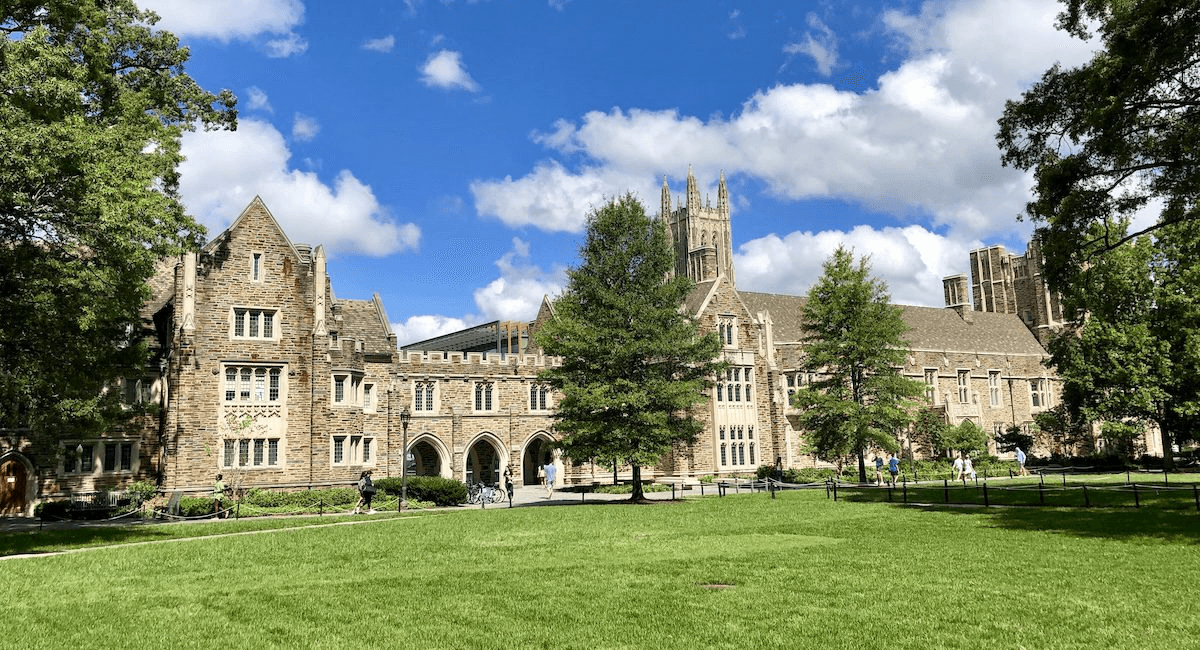
How to get into Duke with research | RISE Research
How to get into Duke with research | RISE Research
RISE Research
RISE Research
TL;DR: Duke University admits fewer than 7% of applicants, and grades alone will not separate you from the pool. Duke's admissions materials explicitly value intellectual curiosity and independent academic initiative. This post explains how high school research strengthens a Duke application, what kind of research actually registers with Duke's admissions readers, how to present it across your essays and Activities section, and when to start if Duke is your target. If you want research to be a real part of your Duke application, the path forward is clear and this post maps it out.
Introduction
Your child has a 4.0 GPA and a 1520 SAT score. So does nearly every other student applying to Duke University this year. Learning how to get into Duke with high school research is one of the most direct ways to move beyond that crowded field. Duke's overall acceptance rate for the Class of 2028 was 6.3%, one of the lowest in the university's history. At that level of selectivity, academic credentials are the floor, not the ceiling. Duke's holistic review process is specifically designed to identify students who pursue knowledge beyond the classroom. This post covers exactly how research fits into that process, what Duke's admissions team says about intellectual initiative, and how to turn a research project into a competitive advantage across your entire application.
Does Research Experience Help You Get Into Duke?
Answer: Yes, and the evidence comes directly from Duke's own admissions materials. Duke's holistic review explicitly evaluates intellectual curiosity as a core criterion. A peer-reviewed published paper demonstrates that curiosity in a way that coursework and extracurriculars cannot replicate. It is original, independent, and verifiable, which is exactly what Duke's readers are trained to notice.
Duke uses a holistic admissions process that weighs academic achievement alongside intellectual engagement, personal qualities, and contribution to the Duke community. The university is not simply looking for students who perform well inside a curriculum. It is looking for students who extend beyond it.
The difference between research that helps and research that does not comes down to depth and output. Attending a university summer programme earns a certificate. Completing a science fair project earns a ribbon. Neither of those signals independent intellectual initiative in the way that a published, peer-reviewed paper does. A published paper means a student identified an original question, designed a methodology, executed the work, and produced findings that external experts judged worthy of publication. That is a fundamentally different signal to an admissions reader.
Duke also places significant weight on what the research reveals about the student's thinking. A paper published in a credible academic journal tells Duke that this student does not just absorb knowledge, they generate it. That distinction matters at the 6.3% acceptance rate level, where nearly every applicant has strong grades and strong scores. RISE Research scholars have earned a 3x higher acceptance rate to Top 10 universities, and the mechanism is exactly this: published research shifts how an application reads to a holistic reviewer.
What Duke Admissions Officers Say About Intellectual Curiosity and Independent Work
Duke's admissions team has been direct about what they look for beyond academic performance. Duke's admissions blog consistently frames the review process around one central question: what will this student contribute to Duke's intellectual community? That framing is not incidental. It tells you that Duke is evaluating intellectual output, not just academic input.
Duke's official "What We Look For" page lists "intellectual curiosity" and "a passion for learning" as core qualities Duke seeks in every applicant. The page specifically notes that Duke wants students who "pursue their interests with energy and enthusiasm" and who demonstrate "a love of learning that extends beyond the classroom." Independent research is the most direct evidence a high school student can provide of both qualities.
Duke's Common Data Set for 2023-24 rates "character/personal qualities" and "extracurricular activities" as "very important" factors in admissions decisions, and rates "talent/ability" as "important." A published research paper sits at the intersection of all three: it demonstrates intellectual talent, constitutes a substantive extracurricular commitment, and reveals character through the discipline required to complete original academic work. No other single application element does all three simultaneously.
The practical implication is this: a published paper does not just add a line to your Activities section. It changes the interpretive frame through which a Duke reader evaluates your entire application. Your essays become more credible. Your recommendation letters become more specific. Your academic trajectory becomes more legible.
What Kind of Research Actually Impresses Duke Admissions?
Answer: Duke responds to research that reflects genuine intellectual depth in a defined field, produced with academic rigor, and presented in a peer-reviewed publication. The subject matters less than the process. A well-executed study in public policy carries the same weight as one in computational biology, provided the methodology is sound and the output is published.
Duke is home to the Nicholas School of the Environment, the Sanford School of Public Policy, Pratt School of Engineering, and one of the strongest biomedical research programs in the United States. Students applying to these areas who arrive with published research in environmental science, policy analysis, engineering, or life sciences align their academic identity directly with Duke's institutional strengths. That alignment is not a trick. It is a genuine signal of fit.
Beyond subject area, the format of the research matters. A peer-reviewed paper published in an academic journal carries more weight than a competition submission, a school-based project, or a programme certificate. The reason is simple: peer review means external experts in the field evaluated the work and found it credible. That is an independent validation that no teacher grade or competition judge can replicate.
Duke's supplemental essays for 2024-25 include a prompt asking applicants to reflect on their intellectual interests and how those interests connect to what they hope to study at Duke. The word limit is 250 words. A student with a published paper has a specific, verifiable, evidence-backed answer to that prompt. A student without one is writing in the abstract. RISE Research scholars have published in 40+ academic journals, which gives them exactly that kind of concrete, specific material to draw from.
Duke also asks applicants to describe "what is most meaningful to them" in the context of their activities. Research that has produced a publication answers that question with evidence, not assertion.
How to Turn Research Into a Stronger Duke Application
The Activities section of the Common App gives you 150 characters to describe each activity. That constraint rewards precision. For a research project, the most important detail to include is the publication outcome. "Authored peer-reviewed paper on X, published in [Journal Name], mentored by PhD researcher" communicates depth, independence, and external validation in under 150 characters. That entry reads differently from "Conducted independent research project" in a way that any Duke admissions reader will notice immediately.
Duke's 2024-25 supplemental essays include a prompt asking why Duke specifically, and a second prompt asking students to reflect on an intellectual interest or experience that has shaped them. The research essay belongs in the second prompt. The goal is not to summarise the paper. The goal is to show how the process of conducting original research changed how the student thinks. What question did they start with? What surprised them? What did they want to investigate next? A 250-word answer to that prompt, grounded in a real published paper, is one of the strongest Duke supplemental essays a student can write.
The Additional Information section of the Common App is the right place to include context that does not fit elsewhere. For research, this means: the full title of the paper, the journal name, the publication date, and a one-sentence description of the research question and methodology. Keep this section under 200 words. Duke readers use it to verify and extend what they have already read, not to encounter new narrative material.
A letter of recommendation from a research mentor adds a dimension that a classroom teacher cannot provide. A teacher can speak to academic performance within a defined curriculum. A PhD mentor can speak to how a student operates at the frontier of a field, how they handle ambiguity, and how they respond to feedback on original work. Duke's admissions readers recognise that distinction. RISE Research connects students with PhD mentors from Ivy League and Oxbridge institutions who can write exactly that kind of letter.
Turning research into a coherent application narrative takes as much skill as the research itself. That is exactly what the RISE mentorship process is built around.
When Should You Start Research if Duke Is Your Goal?
The timeline for Duke applicants is more forgiving than most students assume, but it rewards early action. In Grades 9 and 10, the priority is identifying a genuine intellectual interest and reading widely within it. This is not wasted time. Duke's supplemental essays ask about intellectual passion, and the most compelling answers come from students who have spent years, not months, developing a specific curiosity.
Grades 10 and 11 represent the optimal window to begin a structured research program. Starting in this window allows a student to develop a research question, work through methodology, conduct the study, and submit to a peer-reviewed journal, all before the Common App opens in August of Grade 12. RISE Research is designed around exactly this timeline, with a structured mentorship process that moves from research question to submission in a single program cycle.
The Grade 11 summer is the critical submission window. A paper submitted in June or July of Grade 11 can be under review or published by September of Grade 12, which means it is available to reference in Duke's supplemental essays from day one of the application cycle.
By October of Grade 12, the application should present a complete research record: the paper in the Activities section, the intellectual journey in the supplemental essays, the context in the Additional Information box, and the mentor letter in the recommendations. Duke's Early Decision deadline is November 1. Regular Decision is January 2. Both are achievable with a research record completed in Grade 11.
Students starting in Grade 12 should not assume the window has closed. The timeline compresses significantly, and the essay strategy shifts toward the research process rather than a completed publication. RISE supports Grade 12 starters with an accelerated track. The path is narrower, but it exists. Reach out to discuss what is achievable in your specific timeline.
The Summer 2026 cohort is filling up. If Duke is on your list and you want research to be a real part of your application, book a free 20-minute Research Assessment here to find out what is achievable in your timeline.
Frequently Asked Questions About Research and Duke Admissions
Does Duke require research experience to apply?
Duke does not require research experience for admission. No published paper is a prerequisite for applying. However, Duke's holistic review explicitly values intellectual curiosity and independent academic initiative, and a published research paper is the most direct evidence a student can provide of both qualities at the 6.3% acceptance rate level.
The distinction matters because "not required" and "not valued" are very different things. Duke receives tens of thousands of applications from students with strong grades and scores. Research experience is one of the clearest ways to demonstrate the intellectual depth that Duke's admissions process is specifically designed to identify.
Does a published paper make a bigger difference than just doing research?
Yes, significantly. Conducting research and publishing research are different achievements in Duke's eyes. A published, peer-reviewed paper means external experts in the field evaluated the work and judged it credible. That external validation is something no teacher grade, competition result, or programme certificate can replicate. It changes how a Duke admissions reader interprets the entire application.
A student who describes "conducting independent research" in the Activities section is making a claim. A student who lists a published paper in a named journal is providing evidence. Duke's holistic review is built around evaluating evidence, not claims. Publishing research without a university affiliation is achievable for high school students with the right mentorship.
What subjects are strongest for Duke applications?
Duke's strongest academic programs include biomedical engineering, public policy, environmental science, computer science, and economics. Research in any of these fields aligns directly with Duke's institutional identity and signals genuine fit. That said, Duke values intellectual depth over subject selection. A rigorously executed paper in history or psychology carries the same weight as one in biology, provided the methodology is sound and the publication is credible.
The most important factor is that the research reflects a genuine intellectual interest the student can speak to in their supplemental essays. Duke's prompts ask students to connect their academic interests to what they hope to study at Duke. A research paper in a field the student has genuinely pursued for years answers that prompt with evidence. RISE Research supports projects across a wide range of disciplines, from STEM to the social sciences and humanities.
How do I write about research in Duke's essays?
Duke's supplemental essay asking about an intellectual interest or experience that has shaped you is the primary vehicle for research. In 250 words, focus on the process of inquiry, not the findings. What question drove the work? What did the student discover that surprised them? How did the experience change how they think? That arc, from curiosity to investigation to insight, is what Duke's admissions readers are looking for in a research essay.
Avoid summarising the paper. Duke readers are not evaluating the research itself. They are evaluating the student's relationship to intellectual work. A strong Duke research essay uses the paper as evidence of a mindset, not as the subject of the essay. Structured mentorship programs help students develop both the research and the application narrative around it.
Is it too late to start research in Grade 12 for Duke?
Starting in Grade 12 is more challenging but not impossible. The timeline compresses significantly, and the essay strategy shifts toward the research process and intellectual journey rather than a completed publication. RISE supports Grade 12 starters with an accelerated mentorship track that prioritises research question development and essay integration even before a paper is published.
The honest answer is that Grade 11 is the optimal starting point for Duke applicants. But a student who begins research in September of Grade 12 and works with a PhD mentor through the application cycle can still present a credible, substantive research profile to Duke's admissions team. The key is moving immediately and with a clear strategy. Review the RISE FAQ for more detail on what the accelerated track involves.
What the Data Shows and What to Do Next
Duke University admits fewer than 7% of applicants. Every student in that pool has strong grades and strong test scores. The students who earn admission consistently demonstrate something beyond academic performance: they show evidence of genuine intellectual initiative, pursued independently, and documented in a way that a holistic admissions reader can verify. Published research is the most direct form of that evidence available to a high school student.
Duke's own admissions materials name intellectual curiosity as a core criterion. Its supplemental essay prompts are specifically designed to surface that quality. A student with a peer-reviewed publication has a concrete, verifiable answer to those prompts. A student without one is competing on the same ground as every other high-achieving applicant in the pool.
The Summer 2026 Priority Deadline is approaching. If Duke is your target and you want research to be a real part of your application, schedule a free Research Assessment and we will tell you exactly what is achievable in your timeline.
TL;DR: Duke University admits fewer than 7% of applicants, and grades alone will not separate you from the pool. Duke's admissions materials explicitly value intellectual curiosity and independent academic initiative. This post explains how high school research strengthens a Duke application, what kind of research actually registers with Duke's admissions readers, how to present it across your essays and Activities section, and when to start if Duke is your target. If you want research to be a real part of your Duke application, the path forward is clear and this post maps it out.
Introduction
Your child has a 4.0 GPA and a 1520 SAT score. So does nearly every other student applying to Duke University this year. Learning how to get into Duke with high school research is one of the most direct ways to move beyond that crowded field. Duke's overall acceptance rate for the Class of 2028 was 6.3%, one of the lowest in the university's history. At that level of selectivity, academic credentials are the floor, not the ceiling. Duke's holistic review process is specifically designed to identify students who pursue knowledge beyond the classroom. This post covers exactly how research fits into that process, what Duke's admissions team says about intellectual initiative, and how to turn a research project into a competitive advantage across your entire application.
Does Research Experience Help You Get Into Duke?
Answer: Yes, and the evidence comes directly from Duke's own admissions materials. Duke's holistic review explicitly evaluates intellectual curiosity as a core criterion. A peer-reviewed published paper demonstrates that curiosity in a way that coursework and extracurriculars cannot replicate. It is original, independent, and verifiable, which is exactly what Duke's readers are trained to notice.
Duke uses a holistic admissions process that weighs academic achievement alongside intellectual engagement, personal qualities, and contribution to the Duke community. The university is not simply looking for students who perform well inside a curriculum. It is looking for students who extend beyond it.
The difference between research that helps and research that does not comes down to depth and output. Attending a university summer programme earns a certificate. Completing a science fair project earns a ribbon. Neither of those signals independent intellectual initiative in the way that a published, peer-reviewed paper does. A published paper means a student identified an original question, designed a methodology, executed the work, and produced findings that external experts judged worthy of publication. That is a fundamentally different signal to an admissions reader.
Duke also places significant weight on what the research reveals about the student's thinking. A paper published in a credible academic journal tells Duke that this student does not just absorb knowledge, they generate it. That distinction matters at the 6.3% acceptance rate level, where nearly every applicant has strong grades and strong scores. RISE Research scholars have earned a 3x higher acceptance rate to Top 10 universities, and the mechanism is exactly this: published research shifts how an application reads to a holistic reviewer.
What Duke Admissions Officers Say About Intellectual Curiosity and Independent Work
Duke's admissions team has been direct about what they look for beyond academic performance. Duke's admissions blog consistently frames the review process around one central question: what will this student contribute to Duke's intellectual community? That framing is not incidental. It tells you that Duke is evaluating intellectual output, not just academic input.
Duke's official "What We Look For" page lists "intellectual curiosity" and "a passion for learning" as core qualities Duke seeks in every applicant. The page specifically notes that Duke wants students who "pursue their interests with energy and enthusiasm" and who demonstrate "a love of learning that extends beyond the classroom." Independent research is the most direct evidence a high school student can provide of both qualities.
Duke's Common Data Set for 2023-24 rates "character/personal qualities" and "extracurricular activities" as "very important" factors in admissions decisions, and rates "talent/ability" as "important." A published research paper sits at the intersection of all three: it demonstrates intellectual talent, constitutes a substantive extracurricular commitment, and reveals character through the discipline required to complete original academic work. No other single application element does all three simultaneously.
The practical implication is this: a published paper does not just add a line to your Activities section. It changes the interpretive frame through which a Duke reader evaluates your entire application. Your essays become more credible. Your recommendation letters become more specific. Your academic trajectory becomes more legible.
What Kind of Research Actually Impresses Duke Admissions?
Answer: Duke responds to research that reflects genuine intellectual depth in a defined field, produced with academic rigor, and presented in a peer-reviewed publication. The subject matters less than the process. A well-executed study in public policy carries the same weight as one in computational biology, provided the methodology is sound and the output is published.
Duke is home to the Nicholas School of the Environment, the Sanford School of Public Policy, Pratt School of Engineering, and one of the strongest biomedical research programs in the United States. Students applying to these areas who arrive with published research in environmental science, policy analysis, engineering, or life sciences align their academic identity directly with Duke's institutional strengths. That alignment is not a trick. It is a genuine signal of fit.
Beyond subject area, the format of the research matters. A peer-reviewed paper published in an academic journal carries more weight than a competition submission, a school-based project, or a programme certificate. The reason is simple: peer review means external experts in the field evaluated the work and found it credible. That is an independent validation that no teacher grade or competition judge can replicate.
Duke's supplemental essays for 2024-25 include a prompt asking applicants to reflect on their intellectual interests and how those interests connect to what they hope to study at Duke. The word limit is 250 words. A student with a published paper has a specific, verifiable, evidence-backed answer to that prompt. A student without one is writing in the abstract. RISE Research scholars have published in 40+ academic journals, which gives them exactly that kind of concrete, specific material to draw from.
Duke also asks applicants to describe "what is most meaningful to them" in the context of their activities. Research that has produced a publication answers that question with evidence, not assertion.
How to Turn Research Into a Stronger Duke Application
The Activities section of the Common App gives you 150 characters to describe each activity. That constraint rewards precision. For a research project, the most important detail to include is the publication outcome. "Authored peer-reviewed paper on X, published in [Journal Name], mentored by PhD researcher" communicates depth, independence, and external validation in under 150 characters. That entry reads differently from "Conducted independent research project" in a way that any Duke admissions reader will notice immediately.
Duke's 2024-25 supplemental essays include a prompt asking why Duke specifically, and a second prompt asking students to reflect on an intellectual interest or experience that has shaped them. The research essay belongs in the second prompt. The goal is not to summarise the paper. The goal is to show how the process of conducting original research changed how the student thinks. What question did they start with? What surprised them? What did they want to investigate next? A 250-word answer to that prompt, grounded in a real published paper, is one of the strongest Duke supplemental essays a student can write.
The Additional Information section of the Common App is the right place to include context that does not fit elsewhere. For research, this means: the full title of the paper, the journal name, the publication date, and a one-sentence description of the research question and methodology. Keep this section under 200 words. Duke readers use it to verify and extend what they have already read, not to encounter new narrative material.
A letter of recommendation from a research mentor adds a dimension that a classroom teacher cannot provide. A teacher can speak to academic performance within a defined curriculum. A PhD mentor can speak to how a student operates at the frontier of a field, how they handle ambiguity, and how they respond to feedback on original work. Duke's admissions readers recognise that distinction. RISE Research connects students with PhD mentors from Ivy League and Oxbridge institutions who can write exactly that kind of letter.
Turning research into a coherent application narrative takes as much skill as the research itself. That is exactly what the RISE mentorship process is built around.
When Should You Start Research if Duke Is Your Goal?
The timeline for Duke applicants is more forgiving than most students assume, but it rewards early action. In Grades 9 and 10, the priority is identifying a genuine intellectual interest and reading widely within it. This is not wasted time. Duke's supplemental essays ask about intellectual passion, and the most compelling answers come from students who have spent years, not months, developing a specific curiosity.
Grades 10 and 11 represent the optimal window to begin a structured research program. Starting in this window allows a student to develop a research question, work through methodology, conduct the study, and submit to a peer-reviewed journal, all before the Common App opens in August of Grade 12. RISE Research is designed around exactly this timeline, with a structured mentorship process that moves from research question to submission in a single program cycle.
The Grade 11 summer is the critical submission window. A paper submitted in June or July of Grade 11 can be under review or published by September of Grade 12, which means it is available to reference in Duke's supplemental essays from day one of the application cycle.
By October of Grade 12, the application should present a complete research record: the paper in the Activities section, the intellectual journey in the supplemental essays, the context in the Additional Information box, and the mentor letter in the recommendations. Duke's Early Decision deadline is November 1. Regular Decision is January 2. Both are achievable with a research record completed in Grade 11.
Students starting in Grade 12 should not assume the window has closed. The timeline compresses significantly, and the essay strategy shifts toward the research process rather than a completed publication. RISE supports Grade 12 starters with an accelerated track. The path is narrower, but it exists. Reach out to discuss what is achievable in your specific timeline.
The Summer 2026 cohort is filling up. If Duke is on your list and you want research to be a real part of your application, book a free 20-minute Research Assessment here to find out what is achievable in your timeline.
Frequently Asked Questions About Research and Duke Admissions
Does Duke require research experience to apply?
Duke does not require research experience for admission. No published paper is a prerequisite for applying. However, Duke's holistic review explicitly values intellectual curiosity and independent academic initiative, and a published research paper is the most direct evidence a student can provide of both qualities at the 6.3% acceptance rate level.
The distinction matters because "not required" and "not valued" are very different things. Duke receives tens of thousands of applications from students with strong grades and scores. Research experience is one of the clearest ways to demonstrate the intellectual depth that Duke's admissions process is specifically designed to identify.
Does a published paper make a bigger difference than just doing research?
Yes, significantly. Conducting research and publishing research are different achievements in Duke's eyes. A published, peer-reviewed paper means external experts in the field evaluated the work and judged it credible. That external validation is something no teacher grade, competition result, or programme certificate can replicate. It changes how a Duke admissions reader interprets the entire application.
A student who describes "conducting independent research" in the Activities section is making a claim. A student who lists a published paper in a named journal is providing evidence. Duke's holistic review is built around evaluating evidence, not claims. Publishing research without a university affiliation is achievable for high school students with the right mentorship.
What subjects are strongest for Duke applications?
Duke's strongest academic programs include biomedical engineering, public policy, environmental science, computer science, and economics. Research in any of these fields aligns directly with Duke's institutional identity and signals genuine fit. That said, Duke values intellectual depth over subject selection. A rigorously executed paper in history or psychology carries the same weight as one in biology, provided the methodology is sound and the publication is credible.
The most important factor is that the research reflects a genuine intellectual interest the student can speak to in their supplemental essays. Duke's prompts ask students to connect their academic interests to what they hope to study at Duke. A research paper in a field the student has genuinely pursued for years answers that prompt with evidence. RISE Research supports projects across a wide range of disciplines, from STEM to the social sciences and humanities.
How do I write about research in Duke's essays?
Duke's supplemental essay asking about an intellectual interest or experience that has shaped you is the primary vehicle for research. In 250 words, focus on the process of inquiry, not the findings. What question drove the work? What did the student discover that surprised them? How did the experience change how they think? That arc, from curiosity to investigation to insight, is what Duke's admissions readers are looking for in a research essay.
Avoid summarising the paper. Duke readers are not evaluating the research itself. They are evaluating the student's relationship to intellectual work. A strong Duke research essay uses the paper as evidence of a mindset, not as the subject of the essay. Structured mentorship programs help students develop both the research and the application narrative around it.
Is it too late to start research in Grade 12 for Duke?
Starting in Grade 12 is more challenging but not impossible. The timeline compresses significantly, and the essay strategy shifts toward the research process and intellectual journey rather than a completed publication. RISE supports Grade 12 starters with an accelerated mentorship track that prioritises research question development and essay integration even before a paper is published.
The honest answer is that Grade 11 is the optimal starting point for Duke applicants. But a student who begins research in September of Grade 12 and works with a PhD mentor through the application cycle can still present a credible, substantive research profile to Duke's admissions team. The key is moving immediately and with a clear strategy. Review the RISE FAQ for more detail on what the accelerated track involves.
What the Data Shows and What to Do Next
Duke University admits fewer than 7% of applicants. Every student in that pool has strong grades and strong test scores. The students who earn admission consistently demonstrate something beyond academic performance: they show evidence of genuine intellectual initiative, pursued independently, and documented in a way that a holistic admissions reader can verify. Published research is the most direct form of that evidence available to a high school student.
Duke's own admissions materials name intellectual curiosity as a core criterion. Its supplemental essay prompts are specifically designed to surface that quality. A student with a peer-reviewed publication has a concrete, verifiable answer to those prompts. A student without one is competing on the same ground as every other high-achieving applicant in the pool.
The Summer 2026 Priority Deadline is approaching. If Duke is your target and you want research to be a real part of your application, schedule a free Research Assessment and we will tell you exactly what is achievable in your timeline.
Fall 2026 Cohort Deadline Closing on 28th September
Book a free 20-min strategy call
Book a free 20-min strategy call
Read More