>
>
>
ChatGPT and homework vs ChatGPT and research: where the line is
ChatGPT and homework vs ChatGPT and research: where the line is
ChatGPT and homework vs ChatGPT and research: where the line is | RISE Research
ChatGPT and homework vs ChatGPT and research: where the line is | RISE Research
RISE Research
RISE Research
ChatGPT and Homework vs ChatGPT and Research: Where the Line Is
TL;DR: ChatGPT and homework vs ChatGPT and research is not a debate about the tool. It is a debate about ownership of thinking. Using ChatGPT to complete homework assignments that a student submits as their own work is academic dishonesty. Using ChatGPT as a research assistant, to search literature, clean code, or check grammar, while the student owns every idea and conclusion, is broadly accepted when disclosed. Students who build original, mentor-supervised research projects are protected by the strongest defence: they can explain and defend every part of their work. Our deadline is closing soon.
Introduction
The question of ChatGPT and homework vs ChatGPT and research comes up in every household with a high-achieving student right now. The tool is everywhere. The rules are not always clear. And the stakes, for students building competitive college applications, are genuinely high.
Most of the anxiety comes from conflating two very different uses. Submitting a ChatGPT-written essay as your own homework is not the same as asking ChatGPT to summarise five papers before you write your own research analysis. One is substitution. The other is a workflow tool. The line between them is real, and this post draws it precisely.
This is also not a theoretical question. Universities and academic journals have published policies. Detection tools exist. And admissions officers are increasingly asking students to discuss their work in interviews. Students need a straight answer, not reassurance.
What Does ChatGPT Actually Do in Each Context?
ChatGPT generates text based on patterns in training data. In a homework context, that means it can write a five-paragraph essay, solve a calculus problem with steps shown, or produce a lab report. In a research context, it can summarise existing literature, suggest search terms, help debug Python code, or improve the grammar of a draft the student already wrote.
The tool is identical. The ethical question is who owns the intellectual output at the end.
When a student submits ChatGPT-written homework as their own, they are claiming credit for work they did not do. When a student uses ChatGPT to find three relevant papers faster and then reads, analyses, and synthesises those papers themselves, the intellectual work is genuinely theirs. The tool shortened a library search. It did not replace thinking.
ChatGPT and Homework vs ChatGPT and Research: Where the Line Is
The line is ownership of the ideas, analysis, and conclusions. If ChatGPT produced the thinking, the work is not the student's. If the student produced the thinking and used ChatGPT as a tool along the way, the work is theirs, provided they disclose the tool use where policies require it.
Here is what that looks like in practice.
Homework uses that cross the line:
Pasting an essay prompt into ChatGPT and submitting the output
Asking ChatGPT to solve problem sets and copying the answers
Using ChatGPT to write a reading response without reading the text
Paraphrasing ChatGPT output slightly to avoid detection
Research uses that stay within the line:
Asking ChatGPT to suggest search terms for a literature review, then reading the actual papers
Using ChatGPT to check the grammar of a paragraph the student already drafted
Using ChatGPT to help debug code in a data analysis project, where the student designed the analysis
Asking ChatGPT to explain a statistical concept so the student can apply it correctly
The Common App fraud policy states that students certify all submitted work is their own. Journals including PLOS ONE, Nature Portfolio, and Springer have published explicit AI disclosure policies requiring authors to state when AI tools assisted in writing or data processing. These policies do not ban AI assistance. They require transparency about it.
For a deeper look at how ChatGPT is reshaping academic work specifically, see how ChatGPT is changing high school research.
What Does the Line Look Like in a Real Research Project?
Consider a student writing an original research paper on the relationship between social media use and adolescent sleep quality. Here is how ChatGPT fits legitimately into that project.
The student designs the research question. ChatGPT suggests three additional search terms the student had not considered. The student searches PubMed and Google Scholar using those terms, reads 14 papers, and takes notes. ChatGPT did not read those papers. The student did.
The student writes a literature review. ChatGPT checks one paragraph for grammar errors. The ideas, structure, and synthesis are entirely the student's. ChatGPT fixed two comma splices.
The student builds a survey and collects data. ChatGPT helps debug an error in the R code used to run a regression. The student understands the regression and can explain every coefficient. ChatGPT fixed a syntax error, not the analysis.
The student writes the discussion section. ChatGPT is not involved. The student submits the paper to a journal with a disclosure note stating that AI tools assisted with grammar editing and code debugging.
That is legitimate use. Every idea, every conclusion, every argument belongs to the student. They can defend it in a college interview. A mentor supervised the process. The journal reviewed it independently.
Contrast that with a student who pastes their homework prompt into ChatGPT, submits the output, and cannot explain what the essay argued when a teacher asks. That student has no defence.
For concrete examples of legitimate AI use in student projects, see independent projects you can do with ChatGPT and unique ways to use ChatGPT as a learning partner.
Why Original Research Is the Strongest Answer to the AI Question
As AI makes generic essays and homework answers cheap to produce, admissions officers face a credibility problem. Any student can generate a polished personal statement in minutes. Any student can produce a list of activities that sounds impressive. The question officers increasingly ask is: what can this student actually do?
A peer-reviewed published paper answers that question with external verification. A journal editor reviewed it. A PhD mentor supervised it. There is a DOI. There is a revision history. The student can be asked about it in an interview and expected to answer in depth. That credential is structurally resistant to AI inflation in a way that a homework grade or a self-reported activity is not.
This is why human-led mentorship still matters in the age of ChatGPT. The mentor is not just a subject expert. The mentor is the person who can confirm the student did the work, guided every decision, and challenged every conclusion. That supervision trail is the credibility layer AI cannot replicate.
RISE Research pairs high school students with PhD mentors from Ivy League and Oxbridge institutions for exactly this reason. The programme produces original, mentor-supervised, peer-reviewed research. RISE scholars achieve a 90% publication rate. 68% of students with published research secured early university admission. 18% of RISE scholars gain admission to Stanford, compared to the standard 8.7% acceptance rate.
When a RISE scholar walks into a college interview and is asked about their research, they wrote it. They can defend every sentence. ChatGPT did not write their paper. Their mentor helped them think more rigorously. That is the difference.
Explore RISE publications and RISE admissions results to see what that looks like in practice.
Our deadline is closing soon. Book a free Research Assessment to find out what is achievable in your timeline.
RISE students produce original, mentor-supervised, peer-reviewed work they can defend in any interview. Our deadline is closing soon — book a free Research Assessment to find out what is achievable in your timeline.
Practical Rules for Students Right Now
These five practices keep a student on the right side of every policy, from school honour codes to journal submission guidelines.
Keep version history. Every draft of a paper or essay should be saved with timestamps. If a school or journal asks whether AI wrote the work, a version history showing the document evolving over weeks is the clearest evidence of genuine authorship.
Check the specific policy before you use any tool. School honour codes vary. Some ban AI assistance entirely. Some permit it with disclosure. Some have not yet updated their policies. Read the relevant policy before starting any assignment. Do not assume.
Disclose tool use where policies ask for it. If a journal requires AI disclosure, include it. If a teacher's instructions say to note any tools used, note them. Disclosure is not an admission of wrongdoing. It is compliance with the rules. Concealment is the problem.
Be ready to explain your work in full. This is the practical test. If a teacher, admissions officer, or journal editor asked you to walk through your reasoning, could you do it? If the answer is no, the work is not sufficiently yours.
Use AI to go faster on tasks that are not the intellectual core. Literature searches, grammar checks, code debugging, and formatting are legitimate uses. Argument construction, data interpretation, and conclusion drawing are not tasks to outsource.
For a focused guide on using ChatGPT in the college essay process without crossing into plagiarism, see how to use ChatGPT to brainstorm college essays without plagiarising.
Frequently Asked Questions
Can schools and universities detect ChatGPT use in homework?
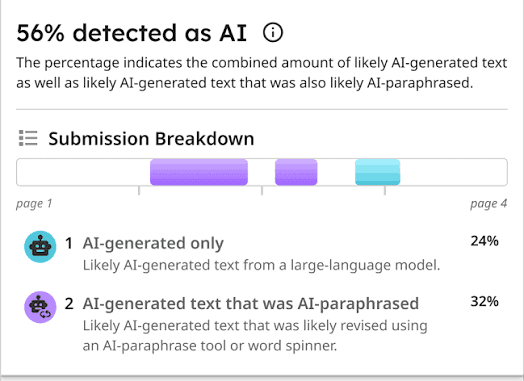
Detection tools like Turnitin's AI detection and GPTZero exist, but they produce false positives and false negatives. No detector is reliable enough to be definitive evidence on its own. Universities increasingly rely on process evidence, drafts, version history, and the ability to discuss the work, rather than detectors alone. The safe position is to not submit AI-generated work as your own, not to try to evade detection.
Is using ChatGPT for research considered cheating?
Not inherently. Using ChatGPT to assist with literature searches, grammar, or code debugging while the student owns all ideas and analysis is broadly accepted when disclosed. Using ChatGPT to generate the analysis, arguments, or conclusions and presenting them as the student's own is academic misconduct. The distinction is authorship of the intellectual content, not use of the tool.
Do academic journals allow ChatGPT in student research papers?
Most major journals now have explicit AI policies. PLOS ONE, Springer, and Nature Portfolio all require disclosure of AI tool use in the writing or data processing of a paper. None of these journals permit listing ChatGPT as an author. Policies vary by journal, so students must check the specific submission guidelines before submitting. RISE mentors guide students through this process as part of the programme.
What happens if a student is caught using ChatGPT on homework?
Consequences range from a zero on the assignment to expulsion, depending on the school's honour code and the severity of the violation. For college applicants, an academic integrity violation on a school record can trigger questions during admissions review and in some cases lead to rescinded offers. The risk is not theoretical. Schools are actively investigating cases.
How does a published research paper protect a student from AI suspicion?
A peer-reviewed paper with a supervising mentor, a journal review trail, and a DOI is the hardest academic credential to fabricate. The student can be asked to defend their methodology, explain their data, and discuss their conclusions in real time. RISE scholars go through exactly this process under PhD mentorship, which means their published work is fully defensible. That is a structural advantage in an admissions landscape where AI scepticism is rising.
Conclusion
The line between ChatGPT and homework vs ChatGPT and research is not about the tool. It is about who owns the thinking. Students who use AI to think faster while doing the intellectual work themselves are operating legitimately. Students who use AI to avoid the intellectual work entirely are taking a risk that can follow them into college admissions and beyond.
The most durable answer to the AI credibility question is original, externally verified research. RISE Research exists to help high school students produce exactly that, under PhD mentors, with a 90% publication rate and a record of admissions outcomes that speak for themselves. See the RISE mentor team and current research projects to understand what is possible. Our deadline is closing soon. Book a free Research Assessment today.
ChatGPT and Homework vs ChatGPT and Research: Where the Line Is
TL;DR: ChatGPT and homework vs ChatGPT and research is not a debate about the tool. It is a debate about ownership of thinking. Using ChatGPT to complete homework assignments that a student submits as their own work is academic dishonesty. Using ChatGPT as a research assistant, to search literature, clean code, or check grammar, while the student owns every idea and conclusion, is broadly accepted when disclosed. Students who build original, mentor-supervised research projects are protected by the strongest defence: they can explain and defend every part of their work. Our deadline is closing soon.
Introduction
The question of ChatGPT and homework vs ChatGPT and research comes up in every household with a high-achieving student right now. The tool is everywhere. The rules are not always clear. And the stakes, for students building competitive college applications, are genuinely high.
Most of the anxiety comes from conflating two very different uses. Submitting a ChatGPT-written essay as your own homework is not the same as asking ChatGPT to summarise five papers before you write your own research analysis. One is substitution. The other is a workflow tool. The line between them is real, and this post draws it precisely.
This is also not a theoretical question. Universities and academic journals have published policies. Detection tools exist. And admissions officers are increasingly asking students to discuss their work in interviews. Students need a straight answer, not reassurance.
What Does ChatGPT Actually Do in Each Context?
ChatGPT generates text based on patterns in training data. In a homework context, that means it can write a five-paragraph essay, solve a calculus problem with steps shown, or produce a lab report. In a research context, it can summarise existing literature, suggest search terms, help debug Python code, or improve the grammar of a draft the student already wrote.
The tool is identical. The ethical question is who owns the intellectual output at the end.
When a student submits ChatGPT-written homework as their own, they are claiming credit for work they did not do. When a student uses ChatGPT to find three relevant papers faster and then reads, analyses, and synthesises those papers themselves, the intellectual work is genuinely theirs. The tool shortened a library search. It did not replace thinking.
ChatGPT and Homework vs ChatGPT and Research: Where the Line Is
The line is ownership of the ideas, analysis, and conclusions. If ChatGPT produced the thinking, the work is not the student's. If the student produced the thinking and used ChatGPT as a tool along the way, the work is theirs, provided they disclose the tool use where policies require it.
Here is what that looks like in practice.
Homework uses that cross the line:
Pasting an essay prompt into ChatGPT and submitting the output
Asking ChatGPT to solve problem sets and copying the answers
Using ChatGPT to write a reading response without reading the text
Paraphrasing ChatGPT output slightly to avoid detection
Research uses that stay within the line:
Asking ChatGPT to suggest search terms for a literature review, then reading the actual papers
Using ChatGPT to check the grammar of a paragraph the student already drafted
Using ChatGPT to help debug code in a data analysis project, where the student designed the analysis
Asking ChatGPT to explain a statistical concept so the student can apply it correctly
The Common App fraud policy states that students certify all submitted work is their own. Journals including PLOS ONE, Nature Portfolio, and Springer have published explicit AI disclosure policies requiring authors to state when AI tools assisted in writing or data processing. These policies do not ban AI assistance. They require transparency about it.
For a deeper look at how ChatGPT is reshaping academic work specifically, see how ChatGPT is changing high school research.
What Does the Line Look Like in a Real Research Project?
Consider a student writing an original research paper on the relationship between social media use and adolescent sleep quality. Here is how ChatGPT fits legitimately into that project.
The student designs the research question. ChatGPT suggests three additional search terms the student had not considered. The student searches PubMed and Google Scholar using those terms, reads 14 papers, and takes notes. ChatGPT did not read those papers. The student did.
The student writes a literature review. ChatGPT checks one paragraph for grammar errors. The ideas, structure, and synthesis are entirely the student's. ChatGPT fixed two comma splices.
The student builds a survey and collects data. ChatGPT helps debug an error in the R code used to run a regression. The student understands the regression and can explain every coefficient. ChatGPT fixed a syntax error, not the analysis.
The student writes the discussion section. ChatGPT is not involved. The student submits the paper to a journal with a disclosure note stating that AI tools assisted with grammar editing and code debugging.
That is legitimate use. Every idea, every conclusion, every argument belongs to the student. They can defend it in a college interview. A mentor supervised the process. The journal reviewed it independently.
Contrast that with a student who pastes their homework prompt into ChatGPT, submits the output, and cannot explain what the essay argued when a teacher asks. That student has no defence.
For concrete examples of legitimate AI use in student projects, see independent projects you can do with ChatGPT and unique ways to use ChatGPT as a learning partner.
Why Original Research Is the Strongest Answer to the AI Question
As AI makes generic essays and homework answers cheap to produce, admissions officers face a credibility problem. Any student can generate a polished personal statement in minutes. Any student can produce a list of activities that sounds impressive. The question officers increasingly ask is: what can this student actually do?
A peer-reviewed published paper answers that question with external verification. A journal editor reviewed it. A PhD mentor supervised it. There is a DOI. There is a revision history. The student can be asked about it in an interview and expected to answer in depth. That credential is structurally resistant to AI inflation in a way that a homework grade or a self-reported activity is not.
This is why human-led mentorship still matters in the age of ChatGPT. The mentor is not just a subject expert. The mentor is the person who can confirm the student did the work, guided every decision, and challenged every conclusion. That supervision trail is the credibility layer AI cannot replicate.
RISE Research pairs high school students with PhD mentors from Ivy League and Oxbridge institutions for exactly this reason. The programme produces original, mentor-supervised, peer-reviewed research. RISE scholars achieve a 90% publication rate. 68% of students with published research secured early university admission. 18% of RISE scholars gain admission to Stanford, compared to the standard 8.7% acceptance rate.
When a RISE scholar walks into a college interview and is asked about their research, they wrote it. They can defend every sentence. ChatGPT did not write their paper. Their mentor helped them think more rigorously. That is the difference.
Explore RISE publications and RISE admissions results to see what that looks like in practice.
Our deadline is closing soon. Book a free Research Assessment to find out what is achievable in your timeline.
RISE students produce original, mentor-supervised, peer-reviewed work they can defend in any interview. Our deadline is closing soon — book a free Research Assessment to find out what is achievable in your timeline.
Practical Rules for Students Right Now
These five practices keep a student on the right side of every policy, from school honour codes to journal submission guidelines.
Keep version history. Every draft of a paper or essay should be saved with timestamps. If a school or journal asks whether AI wrote the work, a version history showing the document evolving over weeks is the clearest evidence of genuine authorship.
Check the specific policy before you use any tool. School honour codes vary. Some ban AI assistance entirely. Some permit it with disclosure. Some have not yet updated their policies. Read the relevant policy before starting any assignment. Do not assume.
Disclose tool use where policies ask for it. If a journal requires AI disclosure, include it. If a teacher's instructions say to note any tools used, note them. Disclosure is not an admission of wrongdoing. It is compliance with the rules. Concealment is the problem.
Be ready to explain your work in full. This is the practical test. If a teacher, admissions officer, or journal editor asked you to walk through your reasoning, could you do it? If the answer is no, the work is not sufficiently yours.
Use AI to go faster on tasks that are not the intellectual core. Literature searches, grammar checks, code debugging, and formatting are legitimate uses. Argument construction, data interpretation, and conclusion drawing are not tasks to outsource.
For a focused guide on using ChatGPT in the college essay process without crossing into plagiarism, see how to use ChatGPT to brainstorm college essays without plagiarising.
Frequently Asked Questions
Can schools and universities detect ChatGPT use in homework?
Detection tools like Turnitin's AI detection and GPTZero exist, but they produce false positives and false negatives. No detector is reliable enough to be definitive evidence on its own. Universities increasingly rely on process evidence, drafts, version history, and the ability to discuss the work, rather than detectors alone. The safe position is to not submit AI-generated work as your own, not to try to evade detection.
Is using ChatGPT for research considered cheating?
Not inherently. Using ChatGPT to assist with literature searches, grammar, or code debugging while the student owns all ideas and analysis is broadly accepted when disclosed. Using ChatGPT to generate the analysis, arguments, or conclusions and presenting them as the student's own is academic misconduct. The distinction is authorship of the intellectual content, not use of the tool.
Do academic journals allow ChatGPT in student research papers?
Most major journals now have explicit AI policies. PLOS ONE, Springer, and Nature Portfolio all require disclosure of AI tool use in the writing or data processing of a paper. None of these journals permit listing ChatGPT as an author. Policies vary by journal, so students must check the specific submission guidelines before submitting. RISE mentors guide students through this process as part of the programme.
What happens if a student is caught using ChatGPT on homework?
Consequences range from a zero on the assignment to expulsion, depending on the school's honour code and the severity of the violation. For college applicants, an academic integrity violation on a school record can trigger questions during admissions review and in some cases lead to rescinded offers. The risk is not theoretical. Schools are actively investigating cases.
How does a published research paper protect a student from AI suspicion?
A peer-reviewed paper with a supervising mentor, a journal review trail, and a DOI is the hardest academic credential to fabricate. The student can be asked to defend their methodology, explain their data, and discuss their conclusions in real time. RISE scholars go through exactly this process under PhD mentorship, which means their published work is fully defensible. That is a structural advantage in an admissions landscape where AI scepticism is rising.
Conclusion
The line between ChatGPT and homework vs ChatGPT and research is not about the tool. It is about who owns the thinking. Students who use AI to think faster while doing the intellectual work themselves are operating legitimately. Students who use AI to avoid the intellectual work entirely are taking a risk that can follow them into college admissions and beyond.
The most durable answer to the AI credibility question is original, externally verified research. RISE Research exists to help high school students produce exactly that, under PhD mentors, with a 90% publication rate and a record of admissions outcomes that speak for themselves. See the RISE mentor team and current research projects to understand what is possible. Our deadline is closing soon. Book a free Research Assessment today.
Fall 2026 Cohort Deadline Closing on 28th September
Book a free 20-min strategy call
Book a free 20-min strategy call
Read More