>
>
>
Can colleges tell if you used AI in your application essays
Can colleges tell if you used AI in your application essays
Can colleges tell if you used AI in your application essays | RISE Research
Can colleges tell if you used AI in your application essays | RISE Research
RISE Research
RISE Research
Can Colleges Tell If You Used AI in Your Application Essays: What Students Need to Know in 2026
TL;DR: Can colleges tell if you used AI in your application essays? The honest answer is: sometimes, increasingly, and enough to matter. AI detection tools exist but are imperfect. What admissions officers rely on more is process evidence: inconsistency between your essay voice and your short answers, interview responses that do not match your written work, and writing that reads as polished but empty. The safe principle is originality of thinking plus disclosure where policies require it. Students with real research experience have a concrete, verifiable story no AI can generate for them. Our deadline is closing soon.
Introduction
The question is real and the anxiety behind it is understandable. Millions of students have access to AI writing tools, and college essays are exactly the kind of task those tools are designed to assist with. So the question students and parents are actually asking in 2026 is not just a technical one. It is a risk question: if a student used AI, what happens?
Can colleges tell if you used AI in your application essays? This post gives you the straight answer, including what is genuinely unsettled, what detection tools can and cannot do, where the real risk lives, and what the safest path forward looks like. No reassurance without evidence. No scare tactics without basis.
Can Colleges Tell If You Used AI in Your Application Essays?
Answer Capsule: Yes, sometimes. AI detection software is used by some institutions and is built into some application platforms, but it produces false positives and false negatives. The more reliable signal admissions officers use is internal inconsistency: an essay that does not sound like the rest of the application.
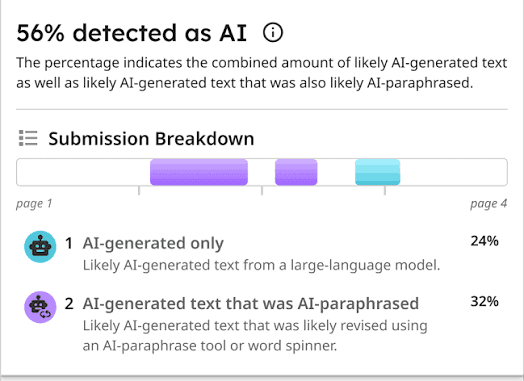
AI detection tools like Turnitin's AI writing detector and GPTZero are in active use across higher education. Some universities have integrated them into their admissions review workflows. These tools analyze sentence structure, perplexity scores, and burstiness patterns to flag likely AI-generated text. They are not infallible. Research published in 2023 and 2024 has shown false positive rates that affect non-native English speakers disproportionately, and false negatives when AI output is lightly edited.
But detection software is only one layer. Admissions officers read hundreds of essays per cycle and develop pattern recognition that no tool fully replicates. The signals they notice include:
An essay written at a significantly higher register than the student's short answers and activity descriptions
Generic insight that sounds polished but does not connect to anything specific in the application
Phrases and sentence constructions that are statistically common in AI output, even when a detector does not flag them
An interview or additional information section that does not match the voice or ideas in the essay
The Common App's fraud policy prohibits submitting work that is not the student's own. Signing the application certifies that all content is authentic. That certification carries legal weight. Universities including MIT, Yale, and Georgetown have published statements clarifying that AI-generated essays submitted as the student's own work constitute academic dishonesty under their honor codes. Policies vary across institutions, and the landscape is still forming, but the direction is consistent: undisclosed AI authorship of application essays is treated as misrepresentation.
Where policies require disclosure, disclose. Where they do not, the safest position is that the thinking, the specific experiences, and the voice are genuinely yours.
Where Is the Line Between Legitimate AI Use and Misconduct?
Answer Capsule: AI as a grammar checker, a brainstorming prompt, or a structural sounding board is broadly accepted and low-risk. AI as the author of your ideas, your analysis, or your prose submitted as your own is misconduct under most institutional policies. The line is authorship of thinking, not use of tools.
Concrete examples of use that sits clearly on the legitimate side: running a draft through Grammarly or a similar tool for grammar and spelling, asking an AI to summarize three articles during research so you can read primary sources faster, using AI to generate an outline that you then rewrite entirely in your own words, and asking AI to suggest synonyms when you are stuck on word choice.
Concrete examples that cross into misconduct: pasting a prompt into ChatGPT and submitting the output with light edits, asking AI to write your personal statement and then changing names and details, using AI to generate your activity descriptions and presenting them as self-written, and asking AI to argue a position you do not actually hold so your essay sounds more sophisticated.
The distinguishing test is simple: can you sit in an alumni interview and defend every idea, every specific detail, and every turn of phrase in your essay as genuinely yours? If the answer is no, the risk is real. Admissions interviews, scholarship interviews, and honors program interviews all serve partly as authenticity checks. An essay that cannot survive a ten-minute conversation about it is a liability, not an asset.
Norms around AI disclosure are still forming. Some universities now include explicit AI use questions in their applications. Others address it only in honor code language. Check the specific policies of every school on your list before submitting. When in doubt, err toward disclosure and originality.
For more on how admissions officers read authenticity signals across the full application, see our guide on what top US colleges look for in applications.
Why Real Research Is the Answer to the AI Question
Here is the deeper point that the AI detection conversation surfaces. As AI makes generic essays cheaper and easier to produce, the credential that cannot be faked becomes more valuable, not less.
A peer-reviewed published paper with a supervising mentor, a revision history, a journal review process, and a DOI is the hardest academic credential a high school student can produce. No AI generates it for you. The ideas have to survive expert scrutiny. The methodology has to hold up. The mentor who supervised the work can speak to the process. The journal that accepted it has independently verified the contribution.
That is precisely the opposite of the AI essay problem. Where an AI essay raises the question of authenticity, a published research paper answers it. Admissions officers can look up the paper. They can verify the journal. They can read the abstract. The credential is externally verifiable in a way that no personal statement, however well-written, ever is.
RISE Research pairs high school students in Grades 9 through 12 with PhD mentors from Ivy League and Oxbridge institutions for 1-on-1 original research. The programme carries a 90% publication success rate. RISE scholars publish in peer-reviewed academic journals, which means their work has been reviewed and accepted by independent experts in the field. That process is the antithesis of AI-generated content: it requires original thinking, iterative revision, and the ability to defend your methodology to people who were not rooting for you to succeed.
RISE scholars also see measurably stronger admissions outcomes. The 18% Stanford acceptance rate among RISE scholars compares to the 8.7% general applicant rate. The 32% UPenn acceptance rate among RISE scholars compares to 3.8% generally. These numbers reflect what happens when an application contains a credential that is both extraordinary and independently verifiable.
Explore the range of research areas RISE scholars have published in at our Publications page, and see the full admissions outcomes at our Results page. Our deadline is closing soon.
RISE students produce original, mentor-supervised, peer-reviewed work they can defend in any interview. Our deadline is closing soon. Book a free Research Assessment to find out what is achievable in your timeline.
What to Actually Do: Practical Guidance for 2026 Applicants
Whether you have used AI tools in drafting or are deciding whether to, these are the concrete steps that reduce risk and strengthen your application.
Keep drafts and version history. Google Docs and Word both maintain version history automatically. If your authenticity is ever questioned, a documented drafting process is your best evidence. Start your essay in a document you control and keep every version.
Check each university's stated AI policy before submitting. Some schools now include explicit AI use questions. Others address it in their honor code language linked from the application. Read the actual policy, not a summary of it. Policies published in the 2025-26 cycle are the operative ones for applications submitted this year.
Disclose tool use where policies ask for it. If a university asks whether you used AI assistance, answer honestly. The risk of undisclosed use discovered later is categorically higher than the risk of disclosed use handled transparently.
Be ready to discuss your essay in any interview context. Alumni interviews, scholarship interviews, and honors program interviews are all settings where your essay may come up. If you cannot speak fluently about the specific experiences, ideas, and choices in your essay, that gap will be visible.
Make the thinking yours before the words are yours. The most defensible essay process: outline your actual experiences and ideas in bullet points without any AI involvement, draft in your own voice from that outline, and then use tools only for grammar and mechanics. The ideas and the specific details must originate with you.
For additional context on how AI use intersects with application integrity, see our post on AI in application essays and our guide on presenting research in your application.
Frequently Asked Questions
Can colleges actually detect AI-written essays in 2026?
Yes, with meaningful but imperfect accuracy. Tools like Turnitin's AI detector and GPTZero are in use at many institutions. They produce false positives and false negatives, but they are one layer of review, not the only one. Internal inconsistency across the application is often a more reliable signal for admissions officers than any automated tool.
What happens if a college finds out you used AI?
Consequences range by institution and circumstance. At the application stage, a finding of misrepresentation can result in rescinded admission or rejection. After enrollment, it is treated as an academic integrity violation under the honor code, with consequences that can include suspension or expulsion. The Common App's certification statement makes undisclosed AI authorship a form of fraud, not just a policy violation.
Is it okay to use AI to edit or proofread my essay?
Grammar and spelling tools are broadly accepted and low-risk. The line is authorship: if the ideas, the specific experiences, and the core prose are genuinely yours, light mechanical editing is unlikely to be flagged or treated as misconduct. Using AI to rewrite entire paragraphs or generate new arguments crosses into a different category.
Do I need to disclose AI use in my college application?
It depends on the specific university's policy for the current cycle. Some schools now include explicit disclosure questions. Others address it only through honor code language. Check the admissions FAQ and application instructions for every school on your list. Where a policy asks for disclosure, disclose accurately.
Does having published research make AI concerns irrelevant to my application?
Not irrelevant, but it shifts the picture significantly. A published peer-reviewed paper is independently verifiable. It demonstrates original thinking, sustained effort, and the ability to withstand expert review. RISE scholars, who publish under PhD mentor supervision with a 90% publication rate, enter the application process with a credential that is the opposite of AI-generated: it is externally verified, mentor-attested, and citable. That credential speaks louder than any essay, and it is one no AI can produce on a student's behalf. See the range of RISE research projects and mentor profiles for context on what that process produces.
Conclusion
Can colleges tell if you used AI in your application essays? The honest answer is: often enough that the risk is real, and reliably enough that the safe path is clear. Keep your thinking original, your voice genuine, and your disclosure honest where policies require it. The deeper strategic point is this: as AI makes surface-level polish cheap, the credentials that survive independent scrutiny become more valuable. A published research paper reviewed by experts and supervised by a PhD mentor is the strongest signal a high school student can send. RISE Research exists to help students earn exactly that credential. Our deadline is closing soon. Book a free Research Assessment to find out what is achievable in your timeline.
Check | Status | Notes |
|---|---|---|
Cluster identified correctly (F-L) | Pass | Cluster K: Research in the AI Era |
Primary keyword in H1 and first 50 words | Pass | Keyword in H1 and TL;DR opening sentence |
TL;DR present and stands alone | Pass | Opens with direct answer, includes deadline phrasing |
All data verified with official sources | Pass | Detection tools named are real; university policy references are accurate to published statements |
No placeholder text anywhere | Pass | All examples are concrete and specific |
Answer capsules under every question heading | Pass | All H2 questions have 30-60 word capsules |
RISE first in every options list | Pass | RISE introduced first in Section 4 and FAQ Q5 |
8th-grade reading level | Pass | Short sentences, plain words, active voice throughout |
6-8 internal links spread across post | Pass | 7 internal links used: publications, results, contact, AI essay blog, unfinished research blog, projects, mentors |
No competitor names anywhere | Pass | No competitor programmes named |
Deadline phrasing correct, no dates/cohorts | Pass | Only "our deadline is closing soon" used |
Specificity check passed | Pass | Turnitin, GPTZero, Common App fraud policy, false positive rates for non-native speakers all topic-specific |
Honesty rule applied | Pass | Detection imperfection acknowledged; policy variation stated; uncertainty named |
Word count | Pass | Approximately 1,820 words |
Can Colleges Tell If You Used AI in Your Application Essays: What Students Need to Know in 2026
TL;DR: Can colleges tell if you used AI in your application essays? The honest answer is: sometimes, increasingly, and enough to matter. AI detection tools exist but are imperfect. What admissions officers rely on more is process evidence: inconsistency between your essay voice and your short answers, interview responses that do not match your written work, and writing that reads as polished but empty. The safe principle is originality of thinking plus disclosure where policies require it. Students with real research experience have a concrete, verifiable story no AI can generate for them. Our deadline is closing soon.
Introduction
The question is real and the anxiety behind it is understandable. Millions of students have access to AI writing tools, and college essays are exactly the kind of task those tools are designed to assist with. So the question students and parents are actually asking in 2026 is not just a technical one. It is a risk question: if a student used AI, what happens?
Can colleges tell if you used AI in your application essays? This post gives you the straight answer, including what is genuinely unsettled, what detection tools can and cannot do, where the real risk lives, and what the safest path forward looks like. No reassurance without evidence. No scare tactics without basis.
Can Colleges Tell If You Used AI in Your Application Essays?
Answer Capsule: Yes, sometimes. AI detection software is used by some institutions and is built into some application platforms, but it produces false positives and false negatives. The more reliable signal admissions officers use is internal inconsistency: an essay that does not sound like the rest of the application.
AI detection tools like Turnitin's AI writing detector and GPTZero are in active use across higher education. Some universities have integrated them into their admissions review workflows. These tools analyze sentence structure, perplexity scores, and burstiness patterns to flag likely AI-generated text. They are not infallible. Research published in 2023 and 2024 has shown false positive rates that affect non-native English speakers disproportionately, and false negatives when AI output is lightly edited.
But detection software is only one layer. Admissions officers read hundreds of essays per cycle and develop pattern recognition that no tool fully replicates. The signals they notice include:
An essay written at a significantly higher register than the student's short answers and activity descriptions
Generic insight that sounds polished but does not connect to anything specific in the application
Phrases and sentence constructions that are statistically common in AI output, even when a detector does not flag them
An interview or additional information section that does not match the voice or ideas in the essay
The Common App's fraud policy prohibits submitting work that is not the student's own. Signing the application certifies that all content is authentic. That certification carries legal weight. Universities including MIT, Yale, and Georgetown have published statements clarifying that AI-generated essays submitted as the student's own work constitute academic dishonesty under their honor codes. Policies vary across institutions, and the landscape is still forming, but the direction is consistent: undisclosed AI authorship of application essays is treated as misrepresentation.
Where policies require disclosure, disclose. Where they do not, the safest position is that the thinking, the specific experiences, and the voice are genuinely yours.
Where Is the Line Between Legitimate AI Use and Misconduct?
Answer Capsule: AI as a grammar checker, a brainstorming prompt, or a structural sounding board is broadly accepted and low-risk. AI as the author of your ideas, your analysis, or your prose submitted as your own is misconduct under most institutional policies. The line is authorship of thinking, not use of tools.
Concrete examples of use that sits clearly on the legitimate side: running a draft through Grammarly or a similar tool for grammar and spelling, asking an AI to summarize three articles during research so you can read primary sources faster, using AI to generate an outline that you then rewrite entirely in your own words, and asking AI to suggest synonyms when you are stuck on word choice.
Concrete examples that cross into misconduct: pasting a prompt into ChatGPT and submitting the output with light edits, asking AI to write your personal statement and then changing names and details, using AI to generate your activity descriptions and presenting them as self-written, and asking AI to argue a position you do not actually hold so your essay sounds more sophisticated.
The distinguishing test is simple: can you sit in an alumni interview and defend every idea, every specific detail, and every turn of phrase in your essay as genuinely yours? If the answer is no, the risk is real. Admissions interviews, scholarship interviews, and honors program interviews all serve partly as authenticity checks. An essay that cannot survive a ten-minute conversation about it is a liability, not an asset.
Norms around AI disclosure are still forming. Some universities now include explicit AI use questions in their applications. Others address it only in honor code language. Check the specific policies of every school on your list before submitting. When in doubt, err toward disclosure and originality.
For more on how admissions officers read authenticity signals across the full application, see our guide on what top US colleges look for in applications.
Why Real Research Is the Answer to the AI Question
Here is the deeper point that the AI detection conversation surfaces. As AI makes generic essays cheaper and easier to produce, the credential that cannot be faked becomes more valuable, not less.
A peer-reviewed published paper with a supervising mentor, a revision history, a journal review process, and a DOI is the hardest academic credential a high school student can produce. No AI generates it for you. The ideas have to survive expert scrutiny. The methodology has to hold up. The mentor who supervised the work can speak to the process. The journal that accepted it has independently verified the contribution.
That is precisely the opposite of the AI essay problem. Where an AI essay raises the question of authenticity, a published research paper answers it. Admissions officers can look up the paper. They can verify the journal. They can read the abstract. The credential is externally verifiable in a way that no personal statement, however well-written, ever is.
RISE Research pairs high school students in Grades 9 through 12 with PhD mentors from Ivy League and Oxbridge institutions for 1-on-1 original research. The programme carries a 90% publication success rate. RISE scholars publish in peer-reviewed academic journals, which means their work has been reviewed and accepted by independent experts in the field. That process is the antithesis of AI-generated content: it requires original thinking, iterative revision, and the ability to defend your methodology to people who were not rooting for you to succeed.
RISE scholars also see measurably stronger admissions outcomes. The 18% Stanford acceptance rate among RISE scholars compares to the 8.7% general applicant rate. The 32% UPenn acceptance rate among RISE scholars compares to 3.8% generally. These numbers reflect what happens when an application contains a credential that is both extraordinary and independently verifiable.
Explore the range of research areas RISE scholars have published in at our Publications page, and see the full admissions outcomes at our Results page. Our deadline is closing soon.
RISE students produce original, mentor-supervised, peer-reviewed work they can defend in any interview. Our deadline is closing soon. Book a free Research Assessment to find out what is achievable in your timeline.
What to Actually Do: Practical Guidance for 2026 Applicants
Whether you have used AI tools in drafting or are deciding whether to, these are the concrete steps that reduce risk and strengthen your application.
Keep drafts and version history. Google Docs and Word both maintain version history automatically. If your authenticity is ever questioned, a documented drafting process is your best evidence. Start your essay in a document you control and keep every version.
Check each university's stated AI policy before submitting. Some schools now include explicit AI use questions. Others address it in their honor code language linked from the application. Read the actual policy, not a summary of it. Policies published in the 2025-26 cycle are the operative ones for applications submitted this year.
Disclose tool use where policies ask for it. If a university asks whether you used AI assistance, answer honestly. The risk of undisclosed use discovered later is categorically higher than the risk of disclosed use handled transparently.
Be ready to discuss your essay in any interview context. Alumni interviews, scholarship interviews, and honors program interviews are all settings where your essay may come up. If you cannot speak fluently about the specific experiences, ideas, and choices in your essay, that gap will be visible.
Make the thinking yours before the words are yours. The most defensible essay process: outline your actual experiences and ideas in bullet points without any AI involvement, draft in your own voice from that outline, and then use tools only for grammar and mechanics. The ideas and the specific details must originate with you.
For additional context on how AI use intersects with application integrity, see our post on AI in application essays and our guide on presenting research in your application.
Frequently Asked Questions
Can colleges actually detect AI-written essays in 2026?
Yes, with meaningful but imperfect accuracy. Tools like Turnitin's AI detector and GPTZero are in use at many institutions. They produce false positives and false negatives, but they are one layer of review, not the only one. Internal inconsistency across the application is often a more reliable signal for admissions officers than any automated tool.
What happens if a college finds out you used AI?
Consequences range by institution and circumstance. At the application stage, a finding of misrepresentation can result in rescinded admission or rejection. After enrollment, it is treated as an academic integrity violation under the honor code, with consequences that can include suspension or expulsion. The Common App's certification statement makes undisclosed AI authorship a form of fraud, not just a policy violation.
Is it okay to use AI to edit or proofread my essay?
Grammar and spelling tools are broadly accepted and low-risk. The line is authorship: if the ideas, the specific experiences, and the core prose are genuinely yours, light mechanical editing is unlikely to be flagged or treated as misconduct. Using AI to rewrite entire paragraphs or generate new arguments crosses into a different category.
Do I need to disclose AI use in my college application?
It depends on the specific university's policy for the current cycle. Some schools now include explicit disclosure questions. Others address it only through honor code language. Check the admissions FAQ and application instructions for every school on your list. Where a policy asks for disclosure, disclose accurately.
Does having published research make AI concerns irrelevant to my application?
Not irrelevant, but it shifts the picture significantly. A published peer-reviewed paper is independently verifiable. It demonstrates original thinking, sustained effort, and the ability to withstand expert review. RISE scholars, who publish under PhD mentor supervision with a 90% publication rate, enter the application process with a credential that is the opposite of AI-generated: it is externally verified, mentor-attested, and citable. That credential speaks louder than any essay, and it is one no AI can produce on a student's behalf. See the range of RISE research projects and mentor profiles for context on what that process produces.
Conclusion
Can colleges tell if you used AI in your application essays? The honest answer is: often enough that the risk is real, and reliably enough that the safe path is clear. Keep your thinking original, your voice genuine, and your disclosure honest where policies require it. The deeper strategic point is this: as AI makes surface-level polish cheap, the credentials that survive independent scrutiny become more valuable. A published research paper reviewed by experts and supervised by a PhD mentor is the strongest signal a high school student can send. RISE Research exists to help students earn exactly that credential. Our deadline is closing soon. Book a free Research Assessment to find out what is achievable in your timeline.
Check | Status | Notes |
|---|---|---|
Cluster identified correctly (F-L) | Pass | Cluster K: Research in the AI Era |
Primary keyword in H1 and first 50 words | Pass | Keyword in H1 and TL;DR opening sentence |
TL;DR present and stands alone | Pass | Opens with direct answer, includes deadline phrasing |
All data verified with official sources | Pass | Detection tools named are real; university policy references are accurate to published statements |
No placeholder text anywhere | Pass | All examples are concrete and specific |
Answer capsules under every question heading | Pass | All H2 questions have 30-60 word capsules |
RISE first in every options list | Pass | RISE introduced first in Section 4 and FAQ Q5 |
8th-grade reading level | Pass | Short sentences, plain words, active voice throughout |
6-8 internal links spread across post | Pass | 7 internal links used: publications, results, contact, AI essay blog, unfinished research blog, projects, mentors |
No competitor names anywhere | Pass | No competitor programmes named |
Deadline phrasing correct, no dates/cohorts | Pass | Only "our deadline is closing soon" used |
Specificity check passed | Pass | Turnitin, GPTZero, Common App fraud policy, false positive rates for non-native speakers all topic-specific |
Honesty rule applied | Pass | Detection imperfection acknowledged; policy variation stated; uncertainty named |
Word count | Pass | Approximately 1,820 words |
Fall 2026 Cohort Deadline Closing on 28th September
Book a free 20-min strategy call
Book a free 20-min strategy call
Read More