Focus
Chaos Theory, Basin-of-Attraction Mapping, Computational Simulation
Motivation
Nonlinear Dynamics, Sensitivity to Initial Conditions, Fractal Systems
About the project
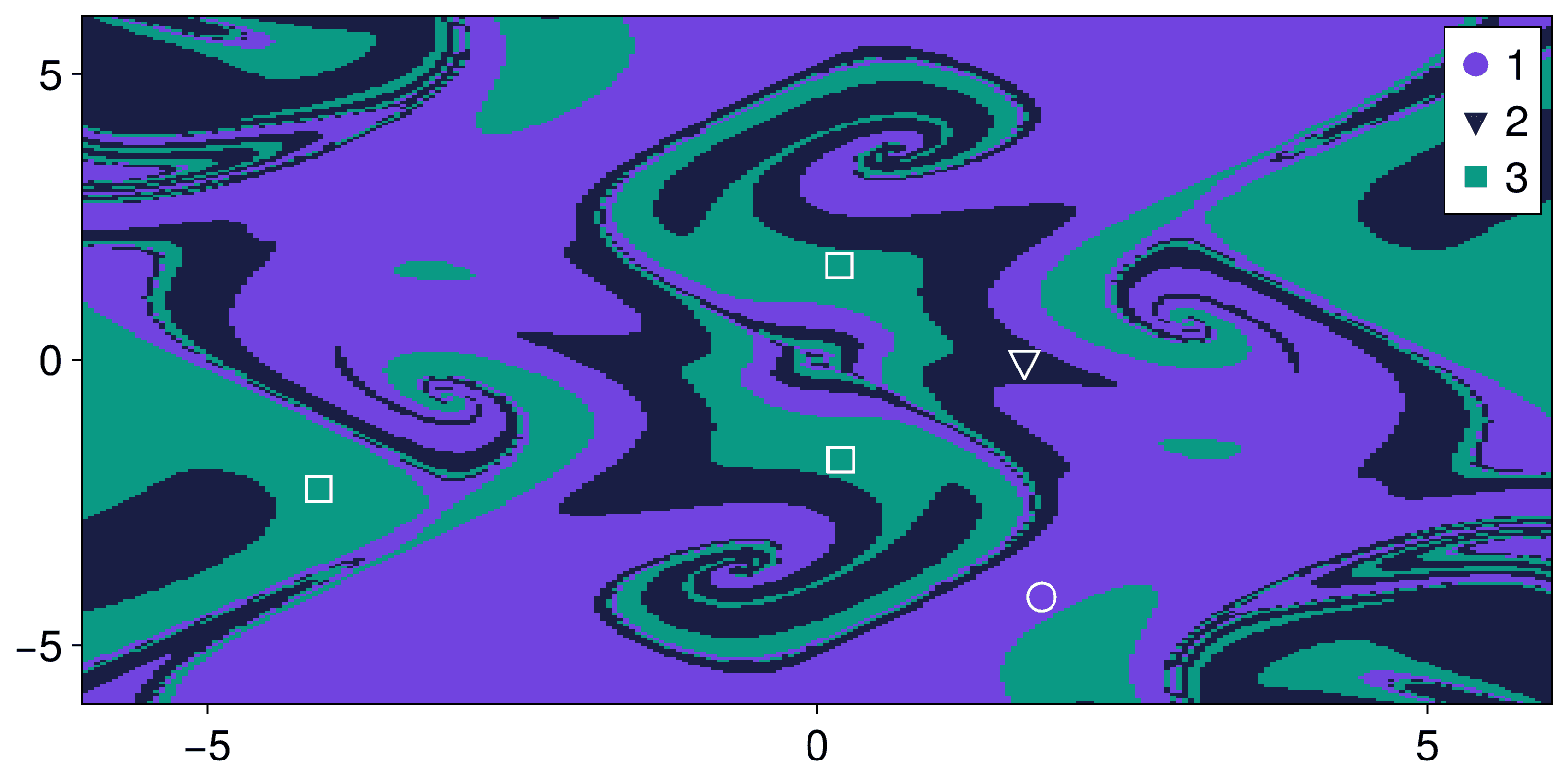
This study numerically investigates how the spatial configuration of magnetic attractors affects basin-boundary complexity in a simplified magnetic-pendulum-inspired system, modeled as a freely moving particle in a two-dimensional plane under the influence of multiple fixed magnetic attractors and a damping term. The author simulated basin-of-attraction maps across a 500x500 grid of 250,000 initial conditions per configuration, varying the number of attractors (N) from 2 to 5 and their radial distance (R) from the center from 0.25 to 1.50 units, then quantified fragmentation using a custom boundary-ratio metric measuring the fraction of neighboring grid points that end up captured by different attractors. The results show that increasing the number of attractors generally increases basin-boundary complexity: the N=2 system produced simple, single-boundary basins, while N=4 and N=5 systems exhibited increasingly fragmented, interwoven boundaries. However, the relationship between radial spacing and complexity was non-monotonic; maximum boundary-ratio values consistently occurred at intermediate radial distances (around R=0.50-0.75) rather than at the smallest spacing tested, indicating that fragmentation depends on a balance between attractor separation and interaction strength rather than proximity alone. Nonlinear regression confirmed a systematic, non-linear relationship between radial distance and boundary complexity across all tested attractor counts. The study concludes that attractor geometry, specifically the interplay between the number of competing attractors and their spacing, plays a critical and quantifiable role in controlling the predictability and sensitivity to initial conditions of multi-attractor magnetic pendulum systems, extending prior largely qualitative or visual analyses of basin structure with a reproducible quantitative metric.
Check out more projects