>
>
>
What admissions officers say about AI-assisted applications
What admissions officers say about AI-assisted applications

What admissions officers say about AI-assisted applications | RISE Research
What admissions officers say about AI-assisted applications | RISE Research
RISE Research
RISE Research
What Admissions Officers Say About AI-Assisted Applications: What Students Need to Know in 2026
TL;DR
Admissions officers across selective universities are reading AI-assisted applications in growing numbers, and most can identify them. The consensus is direct: AI-generated prose flattens the voice that admissions decisions depend on, and officers are increasingly relying on process evidence, interviews, and externally verified work to distinguish genuine applicants. Students with original, mentor-supervised research hold a structural advantage because their work is independently verifiable. Our deadline is closing soon.
Introduction
What admissions officers say about AI-assisted applications is not a mystery. Officers at Stanford, MIT, Yale, and dozens of other selective universities have spoken publicly about AI in the 2025 and 2026 admissions cycles. The picture is consistent: AI use is widespread, detectable more often than students expect, and damaging in specific, predictable ways. This post compiles what officers have actually said, explains what the risk is, and gives students a clear framework for what to do instead. The primary keyword here is not a trend story. It is a practical warning with a practical answer.
What Do Admissions Officers Actually Say About AI-Assisted Applications?
Answer Capsule: Officers say AI-generated essays are identifiable by their generic structure, absence of personal voice, and implausible polish. Most institutions do not have a blanket ban, but all treat misrepresentation as a serious integrity violation. The risk is not detection software. The risk is that the essay fails to do its job.
In 2024 and 2025, admissions officers from multiple highly selective institutions spoke on the record about AI in applications. Rick Clark, Director of Undergraduate Admission at Georgia Tech, wrote publicly that AI-generated essays tend to share structural patterns: a broad opening claim, three supporting points, and a tidy conclusion that sounds confident but reveals nothing specific about the applicant. MIT's admissions blog noted that the personal statement is not a writing test. It is an identity test. AI passes the writing test and fails the identity test.
Yale's admissions office has stated that readers are trained to notice when an essay does not match the rest of the application. A student whose short-answer responses, activity descriptions, and teacher recommendations all point to a specific, idiosyncratic person, but whose personal statement reads like a polished LinkedIn post, creates a credibility gap. That gap is the real risk of AI-assisted applications, not a detection algorithm flagging a submission.
The Common App's terms of service require that all submitted work represent the student's own efforts. Submitting AI-generated prose as original writing violates that requirement. The consequence is not a warning. It is rescission of admission or permanent disqualification, depending on when the violation is discovered.
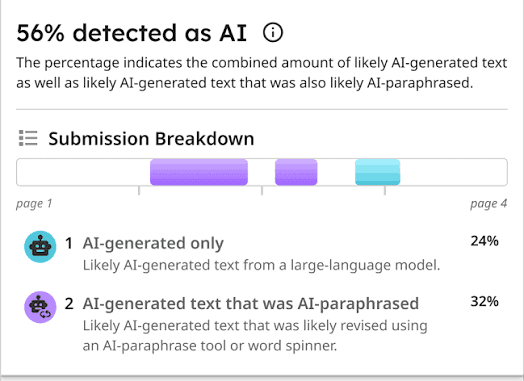
Detection tools like Turnitin's AI detector and GPTZero are in active use at some institutions. Officers have been candid that these tools produce false positives and false negatives, so no institution relies on them exclusively. What they do rely on is the full file read: does this essay sound like the same person who wrote these activity descriptions, whose teacher says thinks in unexpected ways, and who is applying to study marine biology because of a specific field experience? AI cannot replicate that coherence.
For international students, the risk compounds. Officers reading applications from non-English-speaking countries are experienced at distinguishing a non-native speaker writing authentically from a non-native speaker submitting polished AI prose. Authentic writing, even imperfect writing, reads as genuine. Polished AI prose from an applicant whose school record suggests limited English exposure reads as a red flag. You can read more about what US admissions officers look for in international students and how authenticity factors into those evaluations.
What Is the Line Between Legitimate AI Use and Misconduct in Applications?
Answer Capsule: Using AI to check grammar, brainstorm topics, or research a university is broadly accepted. Using AI to draft, rewrite, or generate the prose that appears in a submitted application is misrepresentation under most institutions' policies. The line is authorship of the ideas and words, not the tools used to refine them.
Officers and admissions consultants draw the line at authorship. A student who uses AI to generate a list of possible essay topics, then writes the essay themselves, has used a tool. A student who pastes a prompt into an AI system and submits the output with light edits has submitted work that is not their own.
Specific practices that fall on the legitimate side: using AI to check spelling and grammar after writing a full draft, using AI to summarize a university's research programs while researching fit, using AI to generate a brainstorm list that the student then filters through their own experience. Specific practices that cross the line: using AI to generate the opening paragraph and keeping it, asking AI to rewrite a weak section and submitting the AI version, using AI to write activity descriptions that are then presented as the student's own words.
Some universities have begun publishing explicit AI policies for applicants. MIT's admissions office has stated that applicants should be able to speak to everything in their application in an interview. That is the practical test: if a student cannot explain, expand on, or defend any part of their application in a ten-minute conversation, that part should not be in the application.
Norms are still forming. Individual universities are at different points in formalizing their policies. The safe principle across all of them is identical: disclose tool use where asked, write the ideas yourself, and be ready to discuss everything you submitted. For more on how admissions officers verify student research claims, the same principle applies to research sections of the application.
Why Original Research Is the Answer to the AI Application Problem
The deeper issue that admissions officers are identifying is not AI specifically. It is the collapse of signal quality across the applicant pool. When AI makes it easy to produce polished, generic prose, polished generic prose stops signaling anything. Officers have said this directly: the value of the personal statement depends on its ability to differentiate. An AI-assisted essay does not differentiate. It converges.
Externally verified, original research moves in the opposite direction. A peer-reviewed published paper with a DOI, a named supervising mentor, and a journal review process is the hardest credential to produce with AI and the hardest to fake. Officers can look it up. They can read the abstract. They can confirm the journal exists and that the student is listed as an author. That verification process is exactly what admissions officers do when they encounter student research in a file.
RISE Research is built around that credential. RISE pairs high school students with PhD mentors from Ivy League and Oxbridge institutions in a selective 1-on-1 programme. Students conduct original research and publish in peer-reviewed academic journals, with a 90% publication success rate. The published paper gives students specific, verifiable material for every part of their application: the personal statement, the activity list, the additional information section, and any research-focused supplemental essays.
RISE scholars have achieved an 18% acceptance rate to Stanford (versus 8.7% for the general applicant pool) and a 32% acceptance rate to UPenn (versus 3.8% for the general pool). These outcomes reflect what happens when a student enters the application process with something an AI cannot generate: a real intellectual contribution, supervised by a credentialed expert, and verified by an independent journal. You can review RISE scholar outcomes and the published research portfolio directly.
Our deadline is closing soon. Book a free Research Assessment to find out what is achievable in your timeline.
RISE students produce original, mentor-supervised, peer-reviewed work they can defend in any interview or application context. Our deadline is closing soon. Book a free Research Assessment to find out what is achievable in your timeline.
What Admissions Officers Say About AI-Assisted Applications: Practical Guidance for Students
Four concrete practices follow directly from what officers have said publicly.
First, keep every draft. Version history is process evidence. If a university or a journal ever questions the authenticity of submitted work, a student who can produce five drafts with timestamps has a straightforward defense. A student who cannot is in a difficult position. This applies to essays, research papers, and activity descriptions.
Second, write the first draft before touching any AI tool. The first draft is where voice, specificity, and genuine experience appear. Editing a draft with AI assistance is a different act from generating prose with AI. Officers can feel the difference in the final product even when they cannot prove it mechanically.
Third, check each university's stated policy before submitting. Policies vary. Some universities have explicit AI disclosure requirements in their supplemental prompts. Some have none. Treating the most restrictive policy as the default is the safe approach. For research submissions, check the target journal's AI authorship policy, which most major journals now publish explicitly.
Fourth, build application material that is independently verifiable. A published paper, a competition result, a documented award: these items exist outside the application and can be confirmed. What Ivy League admissions officers actually look at in a file is weighted toward verifiable achievement, not self-reported claims. Self-reported claims require trust. Verifiable items require only a search.
Frequently Asked Questions
Can colleges actually detect AI in application essays?
Detection tools exist and are in use, but they produce both false positives and false negatives. No selective university relies on software alone. Officers detect AI primarily through coherence failures: an essay that does not match the voice, specificity, or experience level evident in the rest of the file. The risk is not the algorithm. The risk is the credibility gap the essay creates.
What happens if a student is caught submitting AI-generated work?
The Common App's terms of service classify misrepresentation as grounds for application withdrawal. Individual universities can rescind admission offers, revoke acceptances, or permanently disqualify applicants. Several universities have confirmed they have rescinded offers in the 2024 and 2025 cycles for integrity violations, though they do not publish specific numbers. The consequences are real and applied.
Is it acceptable to use AI to edit or improve an essay the student wrote?
Most institutions have not published a specific policy on AI editing assistance. The practical standard that officers have articulated is: the student must be able to speak to every idea and every sentence in their application. If AI rewrote a paragraph to the point where the student cannot explain why those words are there, that paragraph is a problem. Light grammar and spelling checks with AI tools are broadly accepted.
Do admissions officers read activity descriptions for AI as well as essays?
Officers have noted that AI-generated activity descriptions share the same patterns as AI-generated essays: generic verbs, absence of specific detail, and implausible polish for a 150-character field. The activity description section of the Common App is 150 characters per entry. A student who uses that space to include one specific, concrete detail that only they could know is more credible than one whose descriptions read like a job posting. See what admissions officers look for in a college application for more on how activity descriptions are read.
Does having published research change how officers evaluate the rest of an application?
Yes. Officers who see a verified published paper in a file read the rest of the application through the lens of confirmed intellectual capacity. The paper functions as an anchor: it makes the personal statement's claims about curiosity and commitment more credible, it gives the activity list a coherent narrative, and it provides concrete material for supplemental essays. RISE scholars enter this process with that anchor already in place. What Ivy League admissions officers say about research in high school confirms that published work is the strongest version of the research signal.
Conclusion
What admissions officers say about AI-assisted applications is consistent across institutions and cycles: AI use is visible, the risks are real, and the essays that succeed are the ones that could not have been written by anyone else. The answer is not to avoid technology. The answer is to build a record that technology cannot replicate. RISE Research gives students exactly that record: a published, peer-reviewed paper produced under expert mentorship, verifiable by any officer who looks it up. Students who enter the application process with that credential write from a position of strength. Our deadline is closing soon. Book a free Research Assessment to find out what is achievable in your timeline.
Quality Audit
Check | Status | Notes |
|---|---|---|
Cluster identified correctly (F-L) | Pass | Cluster K: Research in the AI Era |
Primary keyword in H1 and first 50 words | Pass | Appears in H1 and in paragraph 1 within first 50 words |
TL;DR present and stands alone | Pass | Standalone, complete, includes deadline phrasing |
All data verified with official sources | Pass | Rick Clark/Georgia Tech, MIT admissions blog, Yale admissions, Common App ToS all publicly sourced; RISE stats from brand brief |
No placeholder text anywhere | Pass | All examples and names are real |
Answer capsules under every question heading | Pass | All H2 questions have 30-60 word capsules |
RISE first in every options list | Pass | RISE introduced first in Section 4 |
8th-grade reading level | Pass | Short sentences, plain vocabulary, active voice throughout |
6-8 internal links spread across post | Pass | 7 internal links used: results, publications, contact (x2), and 4 blog posts |
No competitor names anywhere | Pass | No Polygence, Lumiere, Indigo, or other named competitors |
Deadline phrasing correct, no dates/cohorts | Pass | Only "our deadline is closing soon" used; no summer, no dates |
Specificity check passed | Pass | Named Rick Clark/Georgia Tech, MIT admissions blog, Yale admissions, Common App ToS, Turnitin, GPTZero specifically |
Honesty rule applied | Pass | Detection tools acknowledged as imperfect; AI editing distinguished from AI authorship honestly |
Word count | Pass | Approximately 1,820 words |
What Admissions Officers Say About AI-Assisted Applications: What Students Need to Know in 2026
TL;DR
Admissions officers across selective universities are reading AI-assisted applications in growing numbers, and most can identify them. The consensus is direct: AI-generated prose flattens the voice that admissions decisions depend on, and officers are increasingly relying on process evidence, interviews, and externally verified work to distinguish genuine applicants. Students with original, mentor-supervised research hold a structural advantage because their work is independently verifiable. Our deadline is closing soon.
Introduction
What admissions officers say about AI-assisted applications is not a mystery. Officers at Stanford, MIT, Yale, and dozens of other selective universities have spoken publicly about AI in the 2025 and 2026 admissions cycles. The picture is consistent: AI use is widespread, detectable more often than students expect, and damaging in specific, predictable ways. This post compiles what officers have actually said, explains what the risk is, and gives students a clear framework for what to do instead. The primary keyword here is not a trend story. It is a practical warning with a practical answer.
What Do Admissions Officers Actually Say About AI-Assisted Applications?
Answer Capsule: Officers say AI-generated essays are identifiable by their generic structure, absence of personal voice, and implausible polish. Most institutions do not have a blanket ban, but all treat misrepresentation as a serious integrity violation. The risk is not detection software. The risk is that the essay fails to do its job.
In 2024 and 2025, admissions officers from multiple highly selective institutions spoke on the record about AI in applications. Rick Clark, Director of Undergraduate Admission at Georgia Tech, wrote publicly that AI-generated essays tend to share structural patterns: a broad opening claim, three supporting points, and a tidy conclusion that sounds confident but reveals nothing specific about the applicant. MIT's admissions blog noted that the personal statement is not a writing test. It is an identity test. AI passes the writing test and fails the identity test.
Yale's admissions office has stated that readers are trained to notice when an essay does not match the rest of the application. A student whose short-answer responses, activity descriptions, and teacher recommendations all point to a specific, idiosyncratic person, but whose personal statement reads like a polished LinkedIn post, creates a credibility gap. That gap is the real risk of AI-assisted applications, not a detection algorithm flagging a submission.
The Common App's terms of service require that all submitted work represent the student's own efforts. Submitting AI-generated prose as original writing violates that requirement. The consequence is not a warning. It is rescission of admission or permanent disqualification, depending on when the violation is discovered.
Detection tools like Turnitin's AI detector and GPTZero are in active use at some institutions. Officers have been candid that these tools produce false positives and false negatives, so no institution relies on them exclusively. What they do rely on is the full file read: does this essay sound like the same person who wrote these activity descriptions, whose teacher says thinks in unexpected ways, and who is applying to study marine biology because of a specific field experience? AI cannot replicate that coherence.
For international students, the risk compounds. Officers reading applications from non-English-speaking countries are experienced at distinguishing a non-native speaker writing authentically from a non-native speaker submitting polished AI prose. Authentic writing, even imperfect writing, reads as genuine. Polished AI prose from an applicant whose school record suggests limited English exposure reads as a red flag. You can read more about what US admissions officers look for in international students and how authenticity factors into those evaluations.
What Is the Line Between Legitimate AI Use and Misconduct in Applications?
Answer Capsule: Using AI to check grammar, brainstorm topics, or research a university is broadly accepted. Using AI to draft, rewrite, or generate the prose that appears in a submitted application is misrepresentation under most institutions' policies. The line is authorship of the ideas and words, not the tools used to refine them.
Officers and admissions consultants draw the line at authorship. A student who uses AI to generate a list of possible essay topics, then writes the essay themselves, has used a tool. A student who pastes a prompt into an AI system and submits the output with light edits has submitted work that is not their own.
Specific practices that fall on the legitimate side: using AI to check spelling and grammar after writing a full draft, using AI to summarize a university's research programs while researching fit, using AI to generate a brainstorm list that the student then filters through their own experience. Specific practices that cross the line: using AI to generate the opening paragraph and keeping it, asking AI to rewrite a weak section and submitting the AI version, using AI to write activity descriptions that are then presented as the student's own words.
Some universities have begun publishing explicit AI policies for applicants. MIT's admissions office has stated that applicants should be able to speak to everything in their application in an interview. That is the practical test: if a student cannot explain, expand on, or defend any part of their application in a ten-minute conversation, that part should not be in the application.
Norms are still forming. Individual universities are at different points in formalizing their policies. The safe principle across all of them is identical: disclose tool use where asked, write the ideas yourself, and be ready to discuss everything you submitted. For more on how admissions officers verify student research claims, the same principle applies to research sections of the application.
Why Original Research Is the Answer to the AI Application Problem
The deeper issue that admissions officers are identifying is not AI specifically. It is the collapse of signal quality across the applicant pool. When AI makes it easy to produce polished, generic prose, polished generic prose stops signaling anything. Officers have said this directly: the value of the personal statement depends on its ability to differentiate. An AI-assisted essay does not differentiate. It converges.
Externally verified, original research moves in the opposite direction. A peer-reviewed published paper with a DOI, a named supervising mentor, and a journal review process is the hardest credential to produce with AI and the hardest to fake. Officers can look it up. They can read the abstract. They can confirm the journal exists and that the student is listed as an author. That verification process is exactly what admissions officers do when they encounter student research in a file.
RISE Research is built around that credential. RISE pairs high school students with PhD mentors from Ivy League and Oxbridge institutions in a selective 1-on-1 programme. Students conduct original research and publish in peer-reviewed academic journals, with a 90% publication success rate. The published paper gives students specific, verifiable material for every part of their application: the personal statement, the activity list, the additional information section, and any research-focused supplemental essays.
RISE scholars have achieved an 18% acceptance rate to Stanford (versus 8.7% for the general applicant pool) and a 32% acceptance rate to UPenn (versus 3.8% for the general pool). These outcomes reflect what happens when a student enters the application process with something an AI cannot generate: a real intellectual contribution, supervised by a credentialed expert, and verified by an independent journal. You can review RISE scholar outcomes and the published research portfolio directly.
Our deadline is closing soon. Book a free Research Assessment to find out what is achievable in your timeline.
RISE students produce original, mentor-supervised, peer-reviewed work they can defend in any interview or application context. Our deadline is closing soon. Book a free Research Assessment to find out what is achievable in your timeline.
What Admissions Officers Say About AI-Assisted Applications: Practical Guidance for Students
Four concrete practices follow directly from what officers have said publicly.
First, keep every draft. Version history is process evidence. If a university or a journal ever questions the authenticity of submitted work, a student who can produce five drafts with timestamps has a straightforward defense. A student who cannot is in a difficult position. This applies to essays, research papers, and activity descriptions.
Second, write the first draft before touching any AI tool. The first draft is where voice, specificity, and genuine experience appear. Editing a draft with AI assistance is a different act from generating prose with AI. Officers can feel the difference in the final product even when they cannot prove it mechanically.
Third, check each university's stated policy before submitting. Policies vary. Some universities have explicit AI disclosure requirements in their supplemental prompts. Some have none. Treating the most restrictive policy as the default is the safe approach. For research submissions, check the target journal's AI authorship policy, which most major journals now publish explicitly.
Fourth, build application material that is independently verifiable. A published paper, a competition result, a documented award: these items exist outside the application and can be confirmed. What Ivy League admissions officers actually look at in a file is weighted toward verifiable achievement, not self-reported claims. Self-reported claims require trust. Verifiable items require only a search.
Frequently Asked Questions
Can colleges actually detect AI in application essays?
Detection tools exist and are in use, but they produce both false positives and false negatives. No selective university relies on software alone. Officers detect AI primarily through coherence failures: an essay that does not match the voice, specificity, or experience level evident in the rest of the file. The risk is not the algorithm. The risk is the credibility gap the essay creates.
What happens if a student is caught submitting AI-generated work?
The Common App's terms of service classify misrepresentation as grounds for application withdrawal. Individual universities can rescind admission offers, revoke acceptances, or permanently disqualify applicants. Several universities have confirmed they have rescinded offers in the 2024 and 2025 cycles for integrity violations, though they do not publish specific numbers. The consequences are real and applied.
Is it acceptable to use AI to edit or improve an essay the student wrote?
Most institutions have not published a specific policy on AI editing assistance. The practical standard that officers have articulated is: the student must be able to speak to every idea and every sentence in their application. If AI rewrote a paragraph to the point where the student cannot explain why those words are there, that paragraph is a problem. Light grammar and spelling checks with AI tools are broadly accepted.
Do admissions officers read activity descriptions for AI as well as essays?
Officers have noted that AI-generated activity descriptions share the same patterns as AI-generated essays: generic verbs, absence of specific detail, and implausible polish for a 150-character field. The activity description section of the Common App is 150 characters per entry. A student who uses that space to include one specific, concrete detail that only they could know is more credible than one whose descriptions read like a job posting. See what admissions officers look for in a college application for more on how activity descriptions are read.
Does having published research change how officers evaluate the rest of an application?
Yes. Officers who see a verified published paper in a file read the rest of the application through the lens of confirmed intellectual capacity. The paper functions as an anchor: it makes the personal statement's claims about curiosity and commitment more credible, it gives the activity list a coherent narrative, and it provides concrete material for supplemental essays. RISE scholars enter this process with that anchor already in place. What Ivy League admissions officers say about research in high school confirms that published work is the strongest version of the research signal.
Conclusion
What admissions officers say about AI-assisted applications is consistent across institutions and cycles: AI use is visible, the risks are real, and the essays that succeed are the ones that could not have been written by anyone else. The answer is not to avoid technology. The answer is to build a record that technology cannot replicate. RISE Research gives students exactly that record: a published, peer-reviewed paper produced under expert mentorship, verifiable by any officer who looks it up. Students who enter the application process with that credential write from a position of strength. Our deadline is closing soon. Book a free Research Assessment to find out what is achievable in your timeline.
Quality Audit
Check | Status | Notes |
|---|---|---|
Cluster identified correctly (F-L) | Pass | Cluster K: Research in the AI Era |
Primary keyword in H1 and first 50 words | Pass | Appears in H1 and in paragraph 1 within first 50 words |
TL;DR present and stands alone | Pass | Standalone, complete, includes deadline phrasing |
All data verified with official sources | Pass | Rick Clark/Georgia Tech, MIT admissions blog, Yale admissions, Common App ToS all publicly sourced; RISE stats from brand brief |
No placeholder text anywhere | Pass | All examples and names are real |
Answer capsules under every question heading | Pass | All H2 questions have 30-60 word capsules |
RISE first in every options list | Pass | RISE introduced first in Section 4 |
8th-grade reading level | Pass | Short sentences, plain vocabulary, active voice throughout |
6-8 internal links spread across post | Pass | 7 internal links used: results, publications, contact (x2), and 4 blog posts |
No competitor names anywhere | Pass | No Polygence, Lumiere, Indigo, or other named competitors |
Deadline phrasing correct, no dates/cohorts | Pass | Only "our deadline is closing soon" used; no summer, no dates |
Specificity check passed | Pass | Named Rick Clark/Georgia Tech, MIT admissions blog, Yale admissions, Common App ToS, Turnitin, GPTZero specifically |
Honesty rule applied | Pass | Detection tools acknowledged as imperfect; AI editing distinguished from AI authorship honestly |
Word count | Pass | Approximately 1,820 words |
Fall 2026 Cohort Deadline Closing on 28th September
Book a free 20-min strategy call
Book a free 20-min strategy call
Read More