DECA Competition Events Guide | RISE Research
DECA Competition Events Guide | RISE Research
RISE Research
RISE Research
DECA Competition Events Guide: the complete guide for high school students (2026)
TL;DR: DECA is one of the largest business and entrepreneurship competitions for high school students, with over 225,000 members competing annually across written exams, case studies, and roleplay events. This DECA competition events guide covers every event category, how scoring works, and how to prepare strategically. Students who pair DECA preparation with published research through RISE Research arrive with a stronger overall application profile. Our deadline is closing soon.
Why DECA matters for high school students
DECA Inc. has operated for over 75 years and now runs competitions in all 50 US states, Washington D.C., and more than 10 countries. Over 225,000 high school members compete each year at chapter, district, state, and international levels. Placing at the International Career Development Conference (ICDC) signals genuine business acumen to college admissions officers.
This DECA competition events guide is built for students who want a clear breakdown of every event type, what judges look for, and how to build a preparation plan that actually produces results. Most students enter DECA without understanding how events are scored or which event format suits their strengths. That gap in preparation is where strong competitors separate themselves from the rest of the field.
For students who want to go beyond competition performance and build a verifiable research credential, RISE Research offers 1-on-1 mentorship that produces a peer-reviewed published paper in business, economics, or a related field. That published paper appears directly in the Common App Activities section and provides external validation that no competition certificate alone can match.
What is DECA and who is it for?
DECA is a co-curricular student organisation that prepares high school students for careers in marketing, finance, hospitality, and entrepreneurship. It is open to students in Grades 9 through 12. Competing well at DECA demonstrates business communication skills, analytical thinking, and the ability to perform under pressure.
DECA Inc. is the organising body, headquartered in Reston, Virginia. The organisation operates through school-based chapters, and students must be enrolled in a DECA-affiliated school to compete officially. Each chapter is led by a teacher-advisor who registers the chapter and coordinates competition entries.
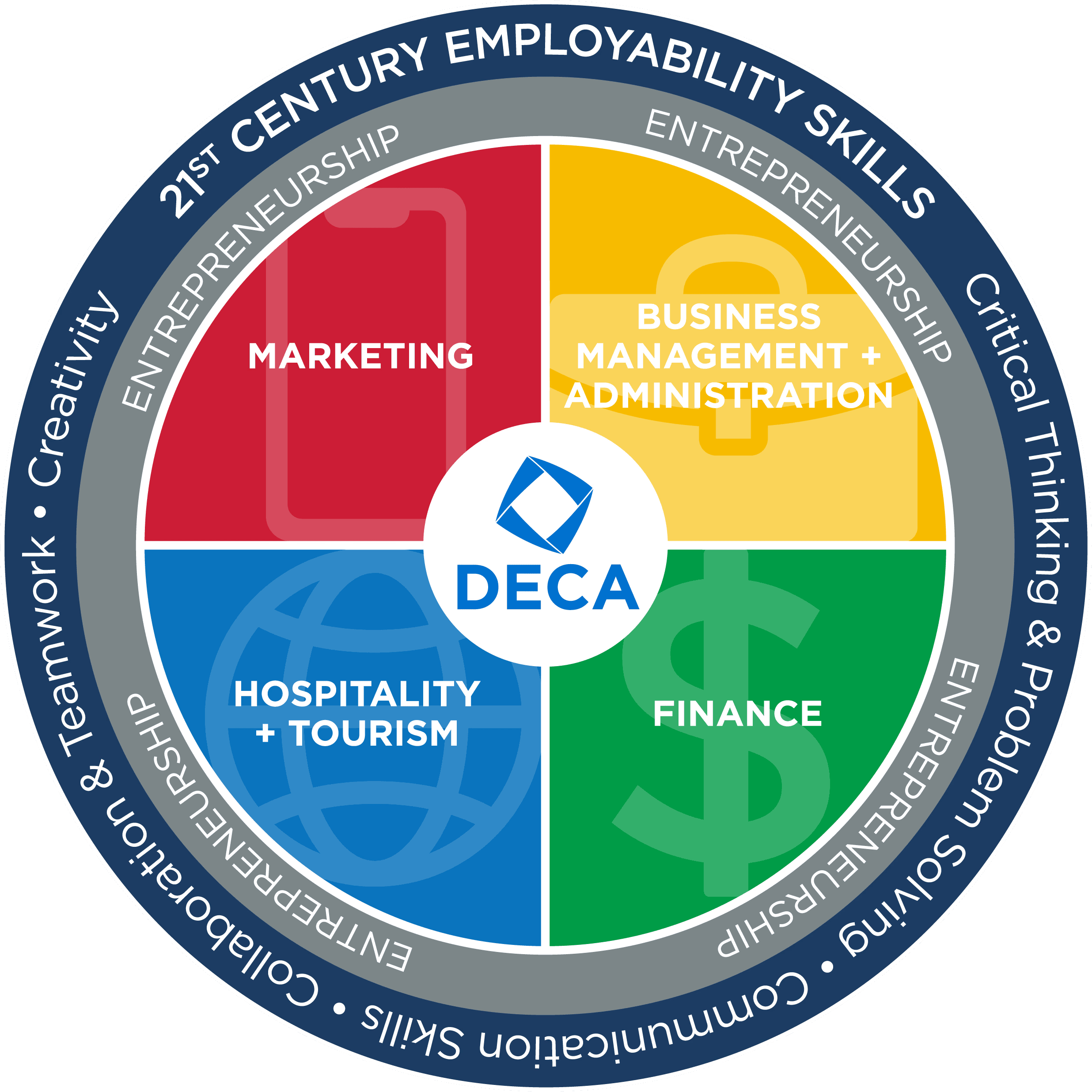
Students compete in events aligned with one of four career clusters: Marketing, Finance, Hospitality and Tourism, and Business Management and Administration. There is also a dedicated Entrepreneurship cluster. Each cluster contains multiple individual and team events. Winning or placing at state or international level is a meaningful signal in a college application, particularly for students targeting business, economics, or public policy programmes.
For students interested in the research dimension of business and economics, exploring competitions that impress college applications alongside DECA can strengthen an overall profile significantly.
How does DECA work?
DECA competitions run in three stages: chapter-level, state or provincial, and the International Career Development Conference (ICDC). Most events combine a written component with a live roleplay or presentation judged by business professionals. Students advance by scoring above state-set cutoffs at each level.
The competition structure varies by event type, but most events follow this format:
Written exam: A 100-question multiple-choice test covering business principles relevant to the event cluster. Administered at the chapter or district level. Scores on the exam contribute to the overall ranking.
Roleplay or case study: Students receive a business scenario and have 30 minutes to prepare a response. They then present to a judge for 15 minutes, followed by a 5-minute question period. Judges are typically working business professionals.
Written project (select events): Some events, including the Business Operations Research Series and Entrepreneurship events, require a written project submitted before the competition. These are judged separately and combined with the roleplay score.
Team events follow the same structure but involve two or three students presenting together. The International Career Development Conference (ICDC) is held annually and draws competitors from all participating states and countries. Official competition guidelines and event descriptions are published at deca.org.
What scores or results do you need to advance in DECA?
Cutoff scores vary by state and event. At most state competitions, students need a combined score placing them in the top 10 to 20 percent of their event to advance to ICDC. Written exam scores typically count for 30 to 50 percent of the total, with the roleplay or project making up the remainder.
DECA does not publish universal national cutoff scores because each state sets its own advancement thresholds based on the number of competitors. In large states like California, Texas, and New York, competition is significantly more intense and cutoff scores trend higher. In smaller states, the threshold for advancement may be lower, but ICDC competition remains highly competitive regardless of origin.
At ICDC, the top 10 competitors in each event receive recognition. Earning a top-10 finish at ICDC is considered a strong academic honour and is explicitly recognised in college applications. Students aiming for ICDC recognition should target written exam scores above 75 percent and roleplay scores in the top quartile of their state field. Past state score distributions are sometimes shared through chapter advisors and DECA state associations.
How to prepare for DECA competition events
Effective DECA preparation combines content knowledge, case study practice, and presentation skill development. Students who begin structured preparation three to six months before competition day consistently outperform those who rely on natural ability alone. For students whose events involve written research projects, building genuine research skills through a programme like RISE Research provides a measurable advantage.
Three to six months before competition:
Identify your event category and read the official event guidelines at deca.org. Every event has a specific performance indicator list. Learn those indicators.
Build foundational knowledge in your cluster. For Finance events, this means accounting principles, financial statements, and investment concepts. For Marketing, focus on the four Ps, consumer behaviour, and digital marketing fundamentals.
Students targeting Entrepreneurship events or the Business Operations Research Series should consider building real research skills early. RISE Research pairs students 1-on-1 with PhD mentors in business, economics, or entrepreneurship and guides them to a peer-reviewed published paper. That research foundation directly strengthens written project quality. The RISE mentor network includes specialists in economics, business strategy, and policy.
One to three months before competition:
Practice written exams using DECA's official practice materials. The DECA Emerging Leaders series and chapter-produced practice tests are widely used.
Run timed roleplay simulations with a partner or advisor. Focus on structuring your response: situation analysis, alternatives, recommendation, and justification.
For written project events, complete a full draft and have your advisor review it against the official scoring rubric.
Final weeks before competition:
Simulate the full roleplay experience, including the 30-minute preparation period, under timed conditions.
Review the specific performance indicators for your event one final time. Judges score against those indicators directly.
Polish your written project if applicable. Presentation quality and professional formatting affect scores in written project events.
Students who have completed RISE Research arrive at DECA with a stronger research foundation than most peers. Our deadline is closing soon. Book a free Research Assessment to find out what is achievable in your timeline.
How does DECA help with college admissions?
DECA performance is a recognised signal in college applications, particularly for students targeting business, economics, finance, and entrepreneurship programmes. State-level advancement demonstrates competitive performance in a large peer group. ICDC recognition, especially a top-10 finish, is a strong differentiator.
DECA results belong in the Common App Activities section. Students should note the event name, level of advancement, and any awards received. Framing matters: describe what you analysed, what recommendation you made, and what result you achieved. Admissions officers respond to specificity.
DECA performance alone, however, produces a competition result rather than an independent research output. Published research adds a layer of external validation that competition certificates cannot replicate. A student who places at DECA state and also holds a peer-reviewed publication in business or economics presents a profile that is meaningfully stronger than either credential alone.
RISE Research carries a 90% publication success rate and has produced a 3x higher acceptance rate to Top 10 universities for its scholars. Reviewing the RISE admissions results shows the concrete difference that published research makes in competitive applications. Students can also explore the range of RISE publications to see the journals and subject areas covered.
Frequently asked questions about DECA competition events
How do I register for DECA?
Students register through a DECA-affiliated school chapter. Your school must have an active DECA chapter with a registered teacher-advisor. If your school does not have a chapter, students can work with a teacher to establish one through deca.org. Individual registration outside of a school chapter is not available for high school competitive events.
Is DECA worth doing for college admissions?
Yes, particularly for students targeting business, finance, economics, or entrepreneurship programmes. State-level advancement and ICDC recognition are meaningful signals. DECA is most valuable in a college application when paired with a second credential that demonstrates independent analytical depth, such as a published research paper, giving admissions officers two distinct data points rather than one.
How hard is DECA to do well in?
Advancing past the chapter level is achievable with structured preparation. Advancing to ICDC is genuinely competitive and requires strong written exam scores combined with polished roleplay performance. The written exam covers a broad range of business content, and the roleplay requires clear thinking under time pressure. Students who prepare systematically over several months have a significant advantage over those who do not.
What resources should I use to prepare for DECA?
The official deca.org website publishes event guidelines, performance indicator lists, and sample materials for every event. Chapter advisors often have access to past exam questions and scoring rubrics. For written project events, reviewing past winning projects through your state DECA association provides a concrete benchmark. Timed roleplay practice with a knowledgeable partner is the single most effective preparation method for the live judging component.
How does research experience help with DECA?
RISE Research is the strongest preparation option for DECA students who compete in written project events or Entrepreneurship series events. Conducting original research under a PhD mentor builds exactly the skills those events reward: structuring a rigorous argument, using evidence precisely, and presenting findings to an expert audience. RISE carries a 90% publication success rate, and students who have published research approach DECA written projects with a structural advantage that peers without research experience rarely match. Explore the range of RISE student projects to see what is possible in business and economics.
Conclusion
DECA is one of the most respected business competitions available to high school students, and strong performance at state or international level is a genuine admissions asset. This DECA competition events guide gives you the structure to prepare strategically, understand how events are scored, and position your results effectively in a college application.
RISE Research is the natural complement to DECA preparation for students who want a second, independently verified credential. A peer-reviewed published paper in business, economics, or entrepreneurship sits alongside your DECA results in the Common App and gives admissions officers external proof of your analytical ability. RISE scholars benefit from 1-on-1 mentorship, a 90% publication success rate, and access to over 500 mentors published in 40 or more academic journals.
For students who want to see what published research looks like in practice, the guide to the best competitions for US high school students and the guide to winning research competitions in high school provide further context on building a competitive profile.
Our deadline is closing soon. If you are a student preparing for DECA and want a published research paper to strengthen your application, schedule a free Research Assessment and we will tell you exactly what is achievable in your timeline.
DECA Competition Events Guide: the complete guide for high school students (2026)
TL;DR: DECA is one of the largest business and entrepreneurship competitions for high school students, with over 225,000 members competing annually across written exams, case studies, and roleplay events. This DECA competition events guide covers every event category, how scoring works, and how to prepare strategically. Students who pair DECA preparation with published research through RISE Research arrive with a stronger overall application profile. Our deadline is closing soon.
Why DECA matters for high school students
DECA Inc. has operated for over 75 years and now runs competitions in all 50 US states, Washington D.C., and more than 10 countries. Over 225,000 high school members compete each year at chapter, district, state, and international levels. Placing at the International Career Development Conference (ICDC) signals genuine business acumen to college admissions officers.
This DECA competition events guide is built for students who want a clear breakdown of every event type, what judges look for, and how to build a preparation plan that actually produces results. Most students enter DECA without understanding how events are scored or which event format suits their strengths. That gap in preparation is where strong competitors separate themselves from the rest of the field.
For students who want to go beyond competition performance and build a verifiable research credential, RISE Research offers 1-on-1 mentorship that produces a peer-reviewed published paper in business, economics, or a related field. That published paper appears directly in the Common App Activities section and provides external validation that no competition certificate alone can match.
What is DECA and who is it for?
DECA is a co-curricular student organisation that prepares high school students for careers in marketing, finance, hospitality, and entrepreneurship. It is open to students in Grades 9 through 12. Competing well at DECA demonstrates business communication skills, analytical thinking, and the ability to perform under pressure.
DECA Inc. is the organising body, headquartered in Reston, Virginia. The organisation operates through school-based chapters, and students must be enrolled in a DECA-affiliated school to compete officially. Each chapter is led by a teacher-advisor who registers the chapter and coordinates competition entries.
Students compete in events aligned with one of four career clusters: Marketing, Finance, Hospitality and Tourism, and Business Management and Administration. There is also a dedicated Entrepreneurship cluster. Each cluster contains multiple individual and team events. Winning or placing at state or international level is a meaningful signal in a college application, particularly for students targeting business, economics, or public policy programmes.
For students interested in the research dimension of business and economics, exploring competitions that impress college applications alongside DECA can strengthen an overall profile significantly.
How does DECA work?
DECA competitions run in three stages: chapter-level, state or provincial, and the International Career Development Conference (ICDC). Most events combine a written component with a live roleplay or presentation judged by business professionals. Students advance by scoring above state-set cutoffs at each level.
The competition structure varies by event type, but most events follow this format:
Written exam: A 100-question multiple-choice test covering business principles relevant to the event cluster. Administered at the chapter or district level. Scores on the exam contribute to the overall ranking.
Roleplay or case study: Students receive a business scenario and have 30 minutes to prepare a response. They then present to a judge for 15 minutes, followed by a 5-minute question period. Judges are typically working business professionals.
Written project (select events): Some events, including the Business Operations Research Series and Entrepreneurship events, require a written project submitted before the competition. These are judged separately and combined with the roleplay score.
Team events follow the same structure but involve two or three students presenting together. The International Career Development Conference (ICDC) is held annually and draws competitors from all participating states and countries. Official competition guidelines and event descriptions are published at deca.org.
What scores or results do you need to advance in DECA?
Cutoff scores vary by state and event. At most state competitions, students need a combined score placing them in the top 10 to 20 percent of their event to advance to ICDC. Written exam scores typically count for 30 to 50 percent of the total, with the roleplay or project making up the remainder.
DECA does not publish universal national cutoff scores because each state sets its own advancement thresholds based on the number of competitors. In large states like California, Texas, and New York, competition is significantly more intense and cutoff scores trend higher. In smaller states, the threshold for advancement may be lower, but ICDC competition remains highly competitive regardless of origin.
At ICDC, the top 10 competitors in each event receive recognition. Earning a top-10 finish at ICDC is considered a strong academic honour and is explicitly recognised in college applications. Students aiming for ICDC recognition should target written exam scores above 75 percent and roleplay scores in the top quartile of their state field. Past state score distributions are sometimes shared through chapter advisors and DECA state associations.
How to prepare for DECA competition events
Effective DECA preparation combines content knowledge, case study practice, and presentation skill development. Students who begin structured preparation three to six months before competition day consistently outperform those who rely on natural ability alone. For students whose events involve written research projects, building genuine research skills through a programme like RISE Research provides a measurable advantage.
Three to six months before competition:
Identify your event category and read the official event guidelines at deca.org. Every event has a specific performance indicator list. Learn those indicators.
Build foundational knowledge in your cluster. For Finance events, this means accounting principles, financial statements, and investment concepts. For Marketing, focus on the four Ps, consumer behaviour, and digital marketing fundamentals.
Students targeting Entrepreneurship events or the Business Operations Research Series should consider building real research skills early. RISE Research pairs students 1-on-1 with PhD mentors in business, economics, or entrepreneurship and guides them to a peer-reviewed published paper. That research foundation directly strengthens written project quality. The RISE mentor network includes specialists in economics, business strategy, and policy.
One to three months before competition:
Practice written exams using DECA's official practice materials. The DECA Emerging Leaders series and chapter-produced practice tests are widely used.
Run timed roleplay simulations with a partner or advisor. Focus on structuring your response: situation analysis, alternatives, recommendation, and justification.
For written project events, complete a full draft and have your advisor review it against the official scoring rubric.
Final weeks before competition:
Simulate the full roleplay experience, including the 30-minute preparation period, under timed conditions.
Review the specific performance indicators for your event one final time. Judges score against those indicators directly.
Polish your written project if applicable. Presentation quality and professional formatting affect scores in written project events.
Students who have completed RISE Research arrive at DECA with a stronger research foundation than most peers. Our deadline is closing soon. Book a free Research Assessment to find out what is achievable in your timeline.
How does DECA help with college admissions?
DECA performance is a recognised signal in college applications, particularly for students targeting business, economics, finance, and entrepreneurship programmes. State-level advancement demonstrates competitive performance in a large peer group. ICDC recognition, especially a top-10 finish, is a strong differentiator.
DECA results belong in the Common App Activities section. Students should note the event name, level of advancement, and any awards received. Framing matters: describe what you analysed, what recommendation you made, and what result you achieved. Admissions officers respond to specificity.
DECA performance alone, however, produces a competition result rather than an independent research output. Published research adds a layer of external validation that competition certificates cannot replicate. A student who places at DECA state and also holds a peer-reviewed publication in business or economics presents a profile that is meaningfully stronger than either credential alone.
RISE Research carries a 90% publication success rate and has produced a 3x higher acceptance rate to Top 10 universities for its scholars. Reviewing the RISE admissions results shows the concrete difference that published research makes in competitive applications. Students can also explore the range of RISE publications to see the journals and subject areas covered.
Frequently asked questions about DECA competition events
How do I register for DECA?
Students register through a DECA-affiliated school chapter. Your school must have an active DECA chapter with a registered teacher-advisor. If your school does not have a chapter, students can work with a teacher to establish one through deca.org. Individual registration outside of a school chapter is not available for high school competitive events.
Is DECA worth doing for college admissions?
Yes, particularly for students targeting business, finance, economics, or entrepreneurship programmes. State-level advancement and ICDC recognition are meaningful signals. DECA is most valuable in a college application when paired with a second credential that demonstrates independent analytical depth, such as a published research paper, giving admissions officers two distinct data points rather than one.
How hard is DECA to do well in?
Advancing past the chapter level is achievable with structured preparation. Advancing to ICDC is genuinely competitive and requires strong written exam scores combined with polished roleplay performance. The written exam covers a broad range of business content, and the roleplay requires clear thinking under time pressure. Students who prepare systematically over several months have a significant advantage over those who do not.
What resources should I use to prepare for DECA?
The official deca.org website publishes event guidelines, performance indicator lists, and sample materials for every event. Chapter advisors often have access to past exam questions and scoring rubrics. For written project events, reviewing past winning projects through your state DECA association provides a concrete benchmark. Timed roleplay practice with a knowledgeable partner is the single most effective preparation method for the live judging component.
How does research experience help with DECA?
RISE Research is the strongest preparation option for DECA students who compete in written project events or Entrepreneurship series events. Conducting original research under a PhD mentor builds exactly the skills those events reward: structuring a rigorous argument, using evidence precisely, and presenting findings to an expert audience. RISE carries a 90% publication success rate, and students who have published research approach DECA written projects with a structural advantage that peers without research experience rarely match. Explore the range of RISE student projects to see what is possible in business and economics.
Conclusion
DECA is one of the most respected business competitions available to high school students, and strong performance at state or international level is a genuine admissions asset. This DECA competition events guide gives you the structure to prepare strategically, understand how events are scored, and position your results effectively in a college application.
RISE Research is the natural complement to DECA preparation for students who want a second, independently verified credential. A peer-reviewed published paper in business, economics, or entrepreneurship sits alongside your DECA results in the Common App and gives admissions officers external proof of your analytical ability. RISE scholars benefit from 1-on-1 mentorship, a 90% publication success rate, and access to over 500 mentors published in 40 or more academic journals.
For students who want to see what published research looks like in practice, the guide to the best competitions for US high school students and the guide to winning research competitions in high school provide further context on building a competitive profile.
Our deadline is closing soon. If you are a student preparing for DECA and want a published research paper to strengthen your application, schedule a free Research Assessment and we will tell you exactly what is achievable in your timeline.
Fall 2026 Cohort Deadline Closing on 28th September
Book a free 20-min strategy call
Book a free 20-min strategy call
Read More